Short, sourced explainers for today's science news: what researchers did, what they found and its potential.

Super Intelligence

AlphaProof Nexus proved open math problems, and Lean checked every step

Infographic: a glowing orb labeled language model, a stack of blocks under a gold check mark labeled Lean checks every step and a grid of 353 tiles with nine raised gold tiles labeled open Erdős problems. Panels explain that Google DeepMind's agents wrote proofs in Lean, that the system settled nine open Erdős problems and proved 44 sequence conjectures and that machine checking spares people a line-by-line re-check, though experts must confirm each problem was stated correctly in Lean. Cards: nine of 353 open Erdős problems, 44 of 492 OEIS conjectures, two of the nine unsolved for more than 50 years. Banner: proofs a computer checked line by line; about 2.5 percent success; the team chose the problems. Source: Science, Oct. 8, 2026.

Google DeepMind's system settled nine open Erdős problems, two of them unsolved for more than 50 years. A proof checker verified every line. (Image: SI illustration)

Science 394(6820), 234–239 · Oct. 8, 2026

Engineering

Wood, wheat straw and sunlight turned seawater into drinking water
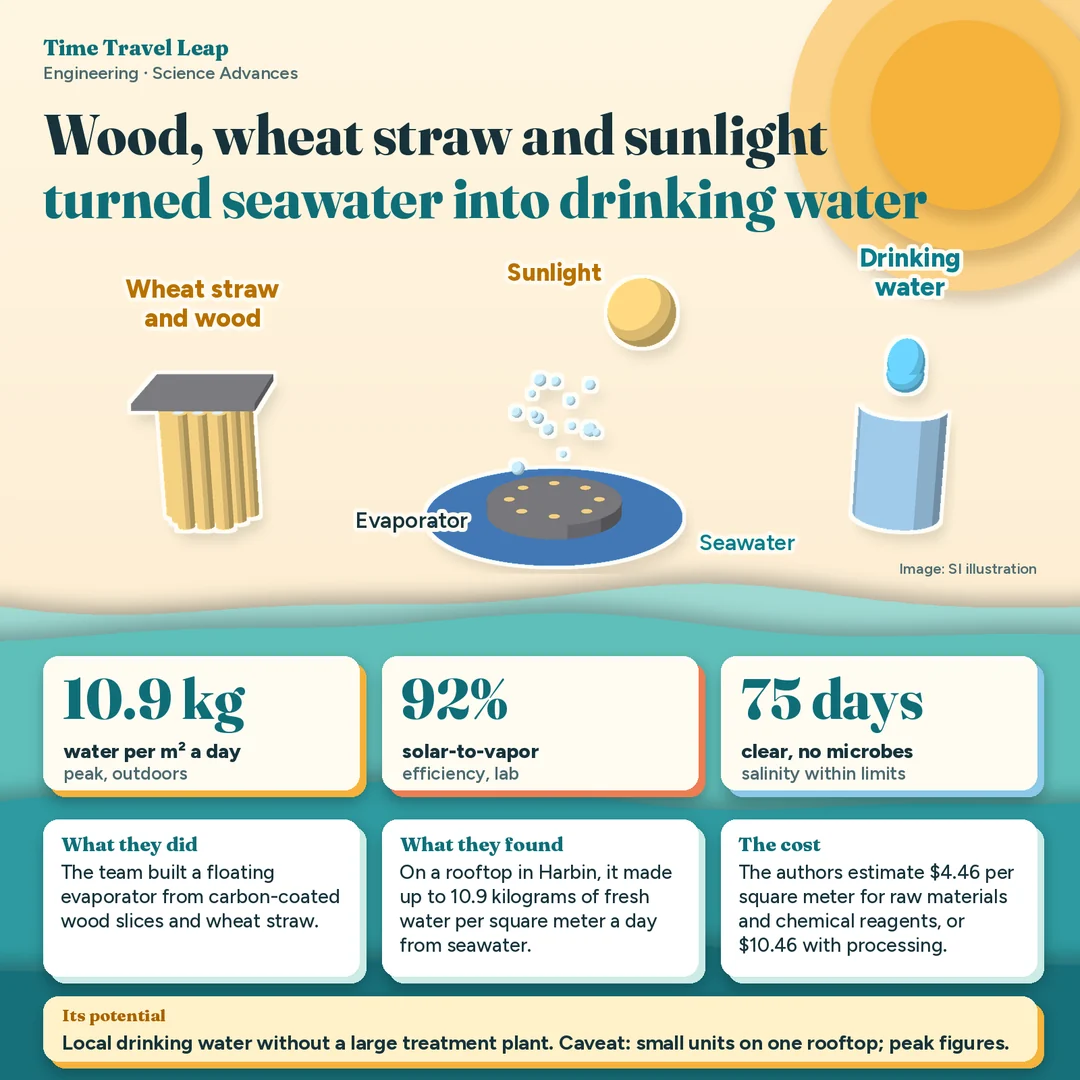
Infographic: a bundle of wheat straws topped with a dark wood slice, a dark evaporator floating on seawater under the sun with rising vapor and a glass of drinking water. Panels explain that the team built a floating evaporator from carbon-coated wood slices and wheat straw, that it made up to 10.9 kilograms of fresh water per square meter a day from seawater on a Harbin rooftop and that the authors estimate $4.46 per square meter for raw materials and chemical reagents, or $10.46 with processing. Cards: 10.9 kilograms per square meter a day at peak, 92 percent solar-to-vapor efficiency in the lab, 75 days of clear water free of microbes with salinity within limits. Banner: small units on one rooftop; peak figures. Source: Science Advances, Oct. 14, 2026.

A small rooftop purifier built from plant materials made drinkable water from seawater for 75 days. It is a field test, not a plant. (Image: SI illustration)

Science Advances 12(42), eaeh3059 · Oct. 14, 2026

Abundance

Recycling old magnets for rare earths, with a modeled fraction of the climate cost
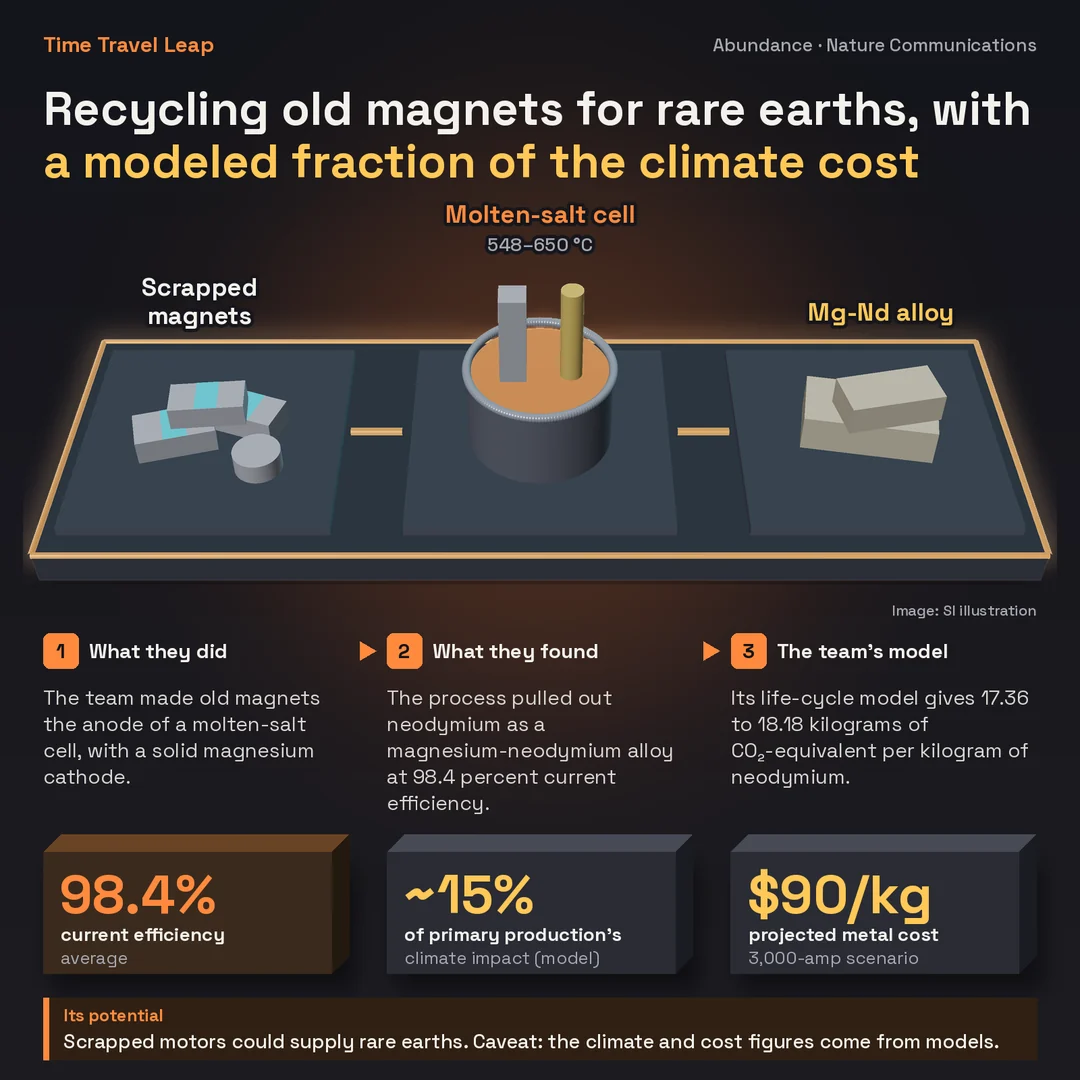
Infographic: a display table that runs left to right from a pile of scrapped magnets to a molten-salt cell at 548 to 650 degrees Celsius with two electrodes in glowing orange salt and ingots labeled Mg-Nd alloy. Panels explain that the team made old magnets the anode of a molten-salt cell with a magnesium cathode, that the process pulled out neodymium as a magnesium-neodymium alloy at 98.4 percent current efficiency and that the team's life-cycle model gives 17.36 to 18.18 kilograms of CO2-equivalent per kilogram of neodymium. Cards: 98.4 percent average current efficiency, about 15 percent of primary production's climate impact (model), $90 per kilogram projected cost in a 3,000-amp scenario. Banner: the climate and cost figures come from models. Source: Nature Communications, Oct. 13, 2026.

A new process recovers neodymium from scrapped magnets. A life-cycle model puts its climate impact at about 15 percent of producing new neodymium from ore. (Image: SI illustration)

Nature Communications · Oct. 13, 2026

Abundance

A crystal-packed membrane lets CO2 race through
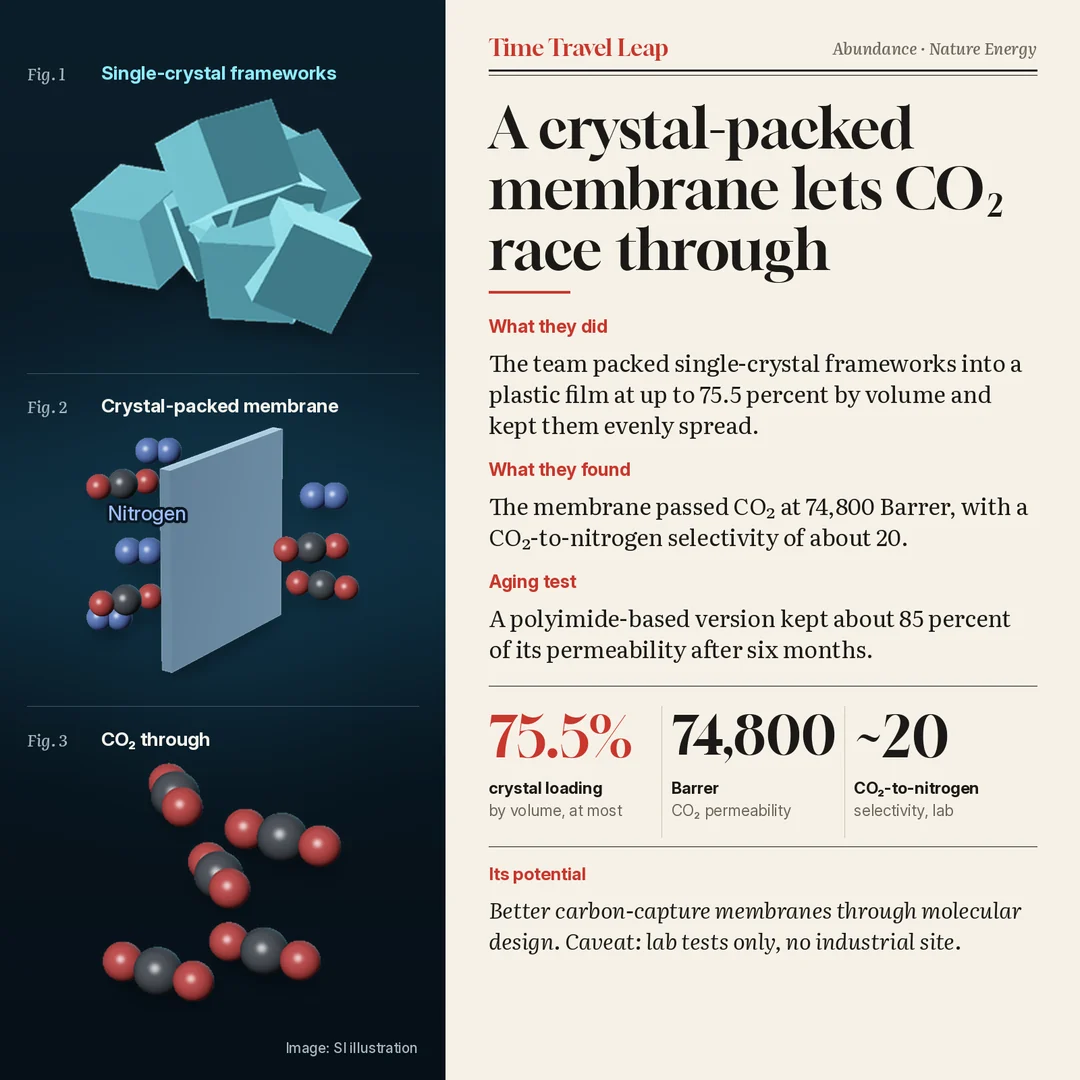
Infographic: three stacked figures beside the text show a cluster of cyan single-crystal frameworks; a translucent crystal-packed membrane with mostly nitrogen molecules held back on one side, and carbon dioxide molecules plus one nitrogen molecule on the other; and carbon dioxide molecules that came through. Panels explain that the team packed the crystals into a plastic film at up to 75.5 percent by volume, that the membrane passed CO2 at 74,800 Barrer with a CO2-to-nitrogen selectivity of about 20 and that a polyimide-based version kept about 85 percent of its permeability after six months. Cards: 75.5 percent crystal loading at most, 74,800 Barrer, selectivity about 20 in lab tests. Banner: lab tests only, no industrial site. Source: Nature Energy, Oct. 7, 2026.

A plastic film loaded with up to 75.5 percent (by volume) single-crystal organic frameworks let carbon dioxide pass very fast in lab tests. (Image: SI illustration)

Nature Energy · Oct. 7, 2026

Super Intelligence

The LACE framework designs its own problem-solving algorithms
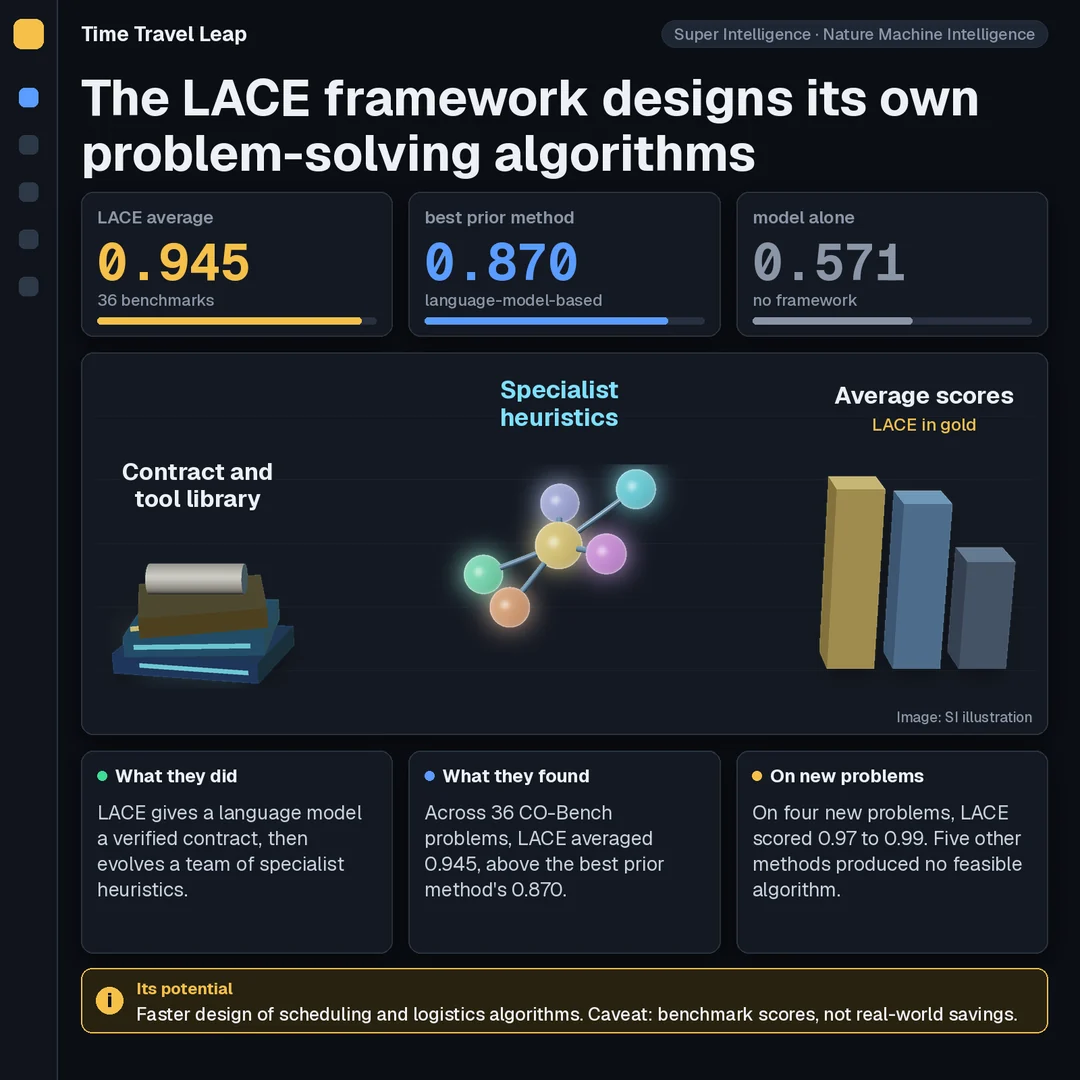
Infographic: a stack of books with a scroll labeled contract and tool library, five glowing spheres linked to a gold center labeled specialist heuristics and a 3D bar chart of average scores with LACE in gold. Panels explain that LACE gives a language model a verified contract and evolves specialist heuristics, that it averaged 0.945 across 36 CO-Bench problems against 0.870 for the best prior method and that it scored 0.97 to 0.99 on four new problems where five other methods produced no feasible algorithm. Cards: 0.945 LACE average, 0.870 best prior method, 0.571 language model alone. Banner: benchmark scores, not real-world savings. Source: Nature Machine Intelligence, Oct. 1, 2026.

LACE outscored other Super Intelligence methods on average across 36 classic optimization benchmarks. The scores are benchmark results, not real-world savings. (Image: SI illustration)

Nature Machine Intelligence · Oct. 1, 2026

Engineering

MonoRace, a one-camera drone, beat former world champions
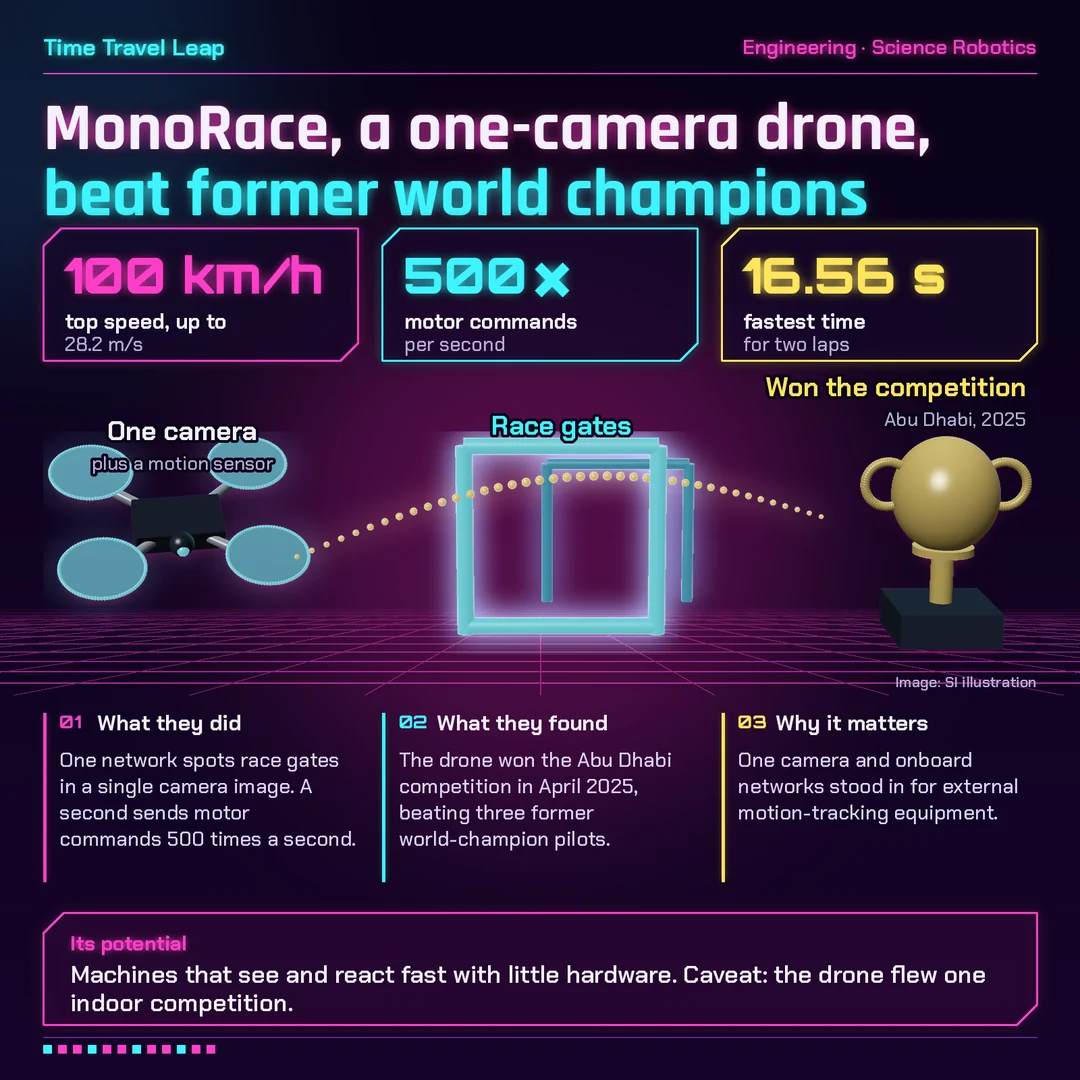
Infographic: a quadcopter drone with one camera, a glowing race gate with a gold flight path and a gold trophy labeled won the competition, Abu Dhabi 2025. Panels explain that one network spots gates in a single camera image while a second sends motor commands 500 times a second, and that the drone beat three former world-champion pilots. Cards: top speed up to 100 kilometers per hour (28.2 meters per second), 500 motor commands per second, fastest time 16.56 seconds for two laps. Banner: the drone flew one indoor competition. Source: Science Robotics, Oct. 14, 2026.

A racing drone that sees with a single camera and a motion sensor won an international competition, beating three former world-champion human pilots. (Image: SI illustration)

Science Robotics 11(119), eaee9250 · Oct. 14, 2026

Abundance

A temporary liquid helps build better solar cells
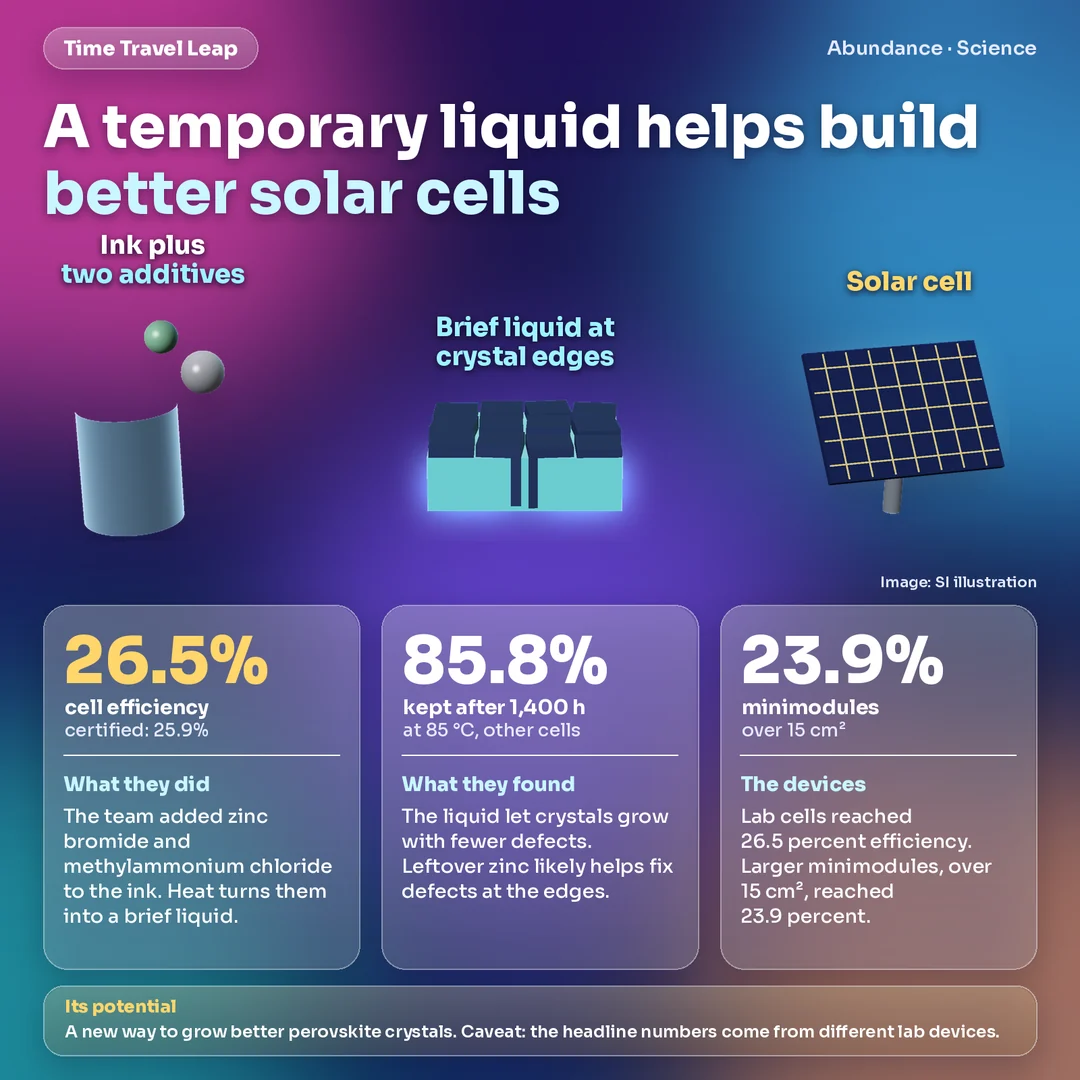
Infographic: a beaker of perovskite ink with two additive spheres, a block of crystal grains with glowing liquid at their edges and a solar cell. Panels explain that the team added zinc bromide and methylammonium chloride to the ink, that the brief liquid let crystals grow with fewer defects and that lab cells reached 26.5 percent efficiency while larger minimodules reached 23.9 percent. Cards: 26.5 percent cell efficiency (25.9 percent independently certified), 85.8 percent kept after 1,400 hours at 85 degrees Celsius in separate cells, 23.9 percent for minimodules over 15 square centimeters. Banner: the headline numbers come from different lab devices. Source: Science, Oct. 8, 2026.

A short-lived liquid that forms between growing crystals pushed perovskite solar cells to 26.5 percent efficiency, a step toward abundant solar power. (Image: SI illustration)

Science 394(6820), 228–233 · Oct. 8, 2026 (in print)

Convergence

Light on about 20 neurons triggered a learned movement
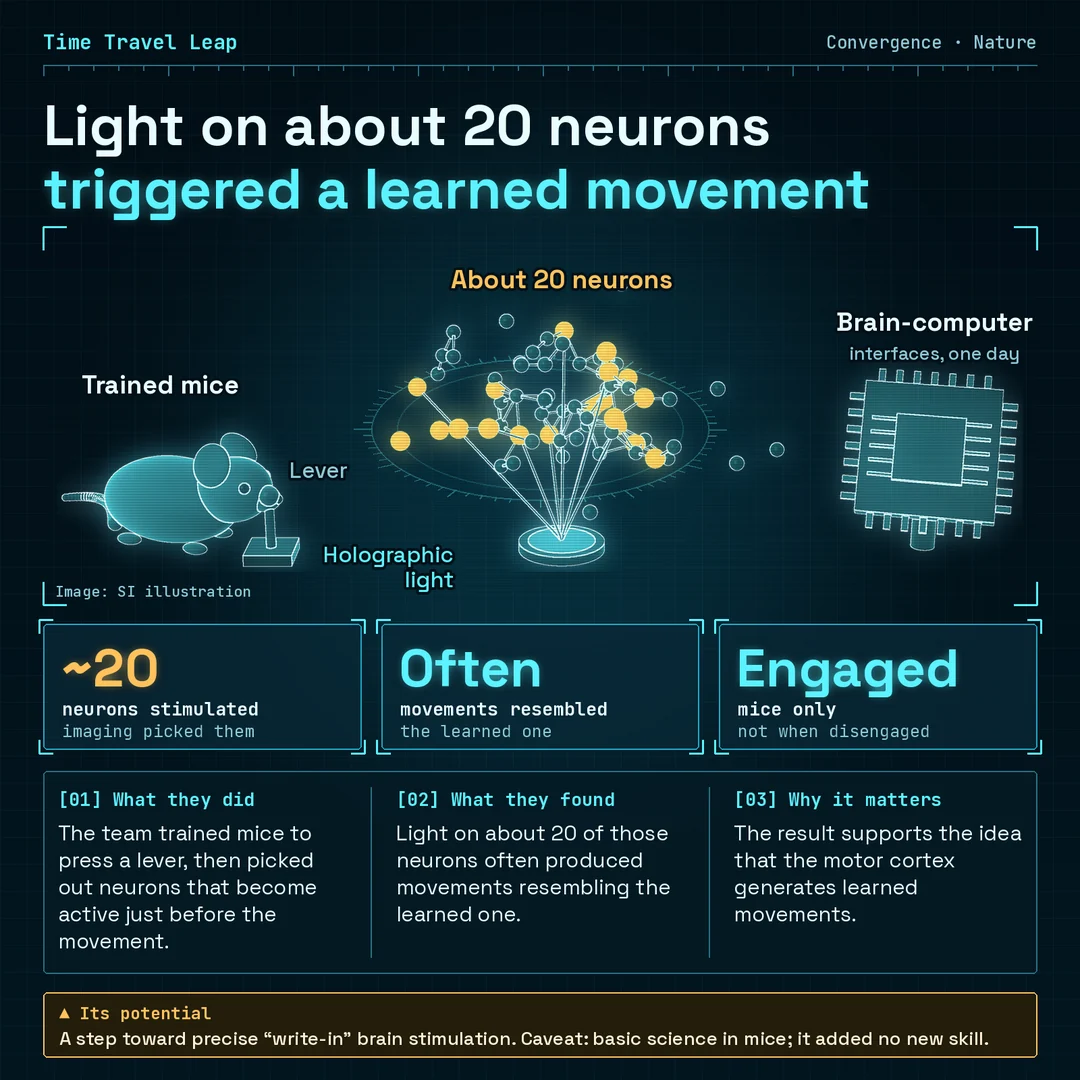
Infographic: a holographic mouse beside a lever, a cluster of neurons in which a holographic light source beams onto about 20 glowing gold ones and a circuit chip labeled brain-computer interfaces, one day. Panels explain that the team trained mice to press a lever, that light on about 20 neurons often produced movements resembling the learned one and that the result supports the idea that the motor cortex generates learned movements. Cards: about 20 neurons stimulated, movements often resembled the learned one, engaged mice only, not when disengaged. Banner: basic science in mice; it added no new skill. Source: Nature, Oct. 14, 2026.

In mice, stimulating a small, precisely chosen group of brain cells often produced movements resembling a skill the animals had already learned. (Image: SI illustration)

Nature · Oct. 14, 2026

Space

JWST mapped a planet's atmosphere all the way around its edge
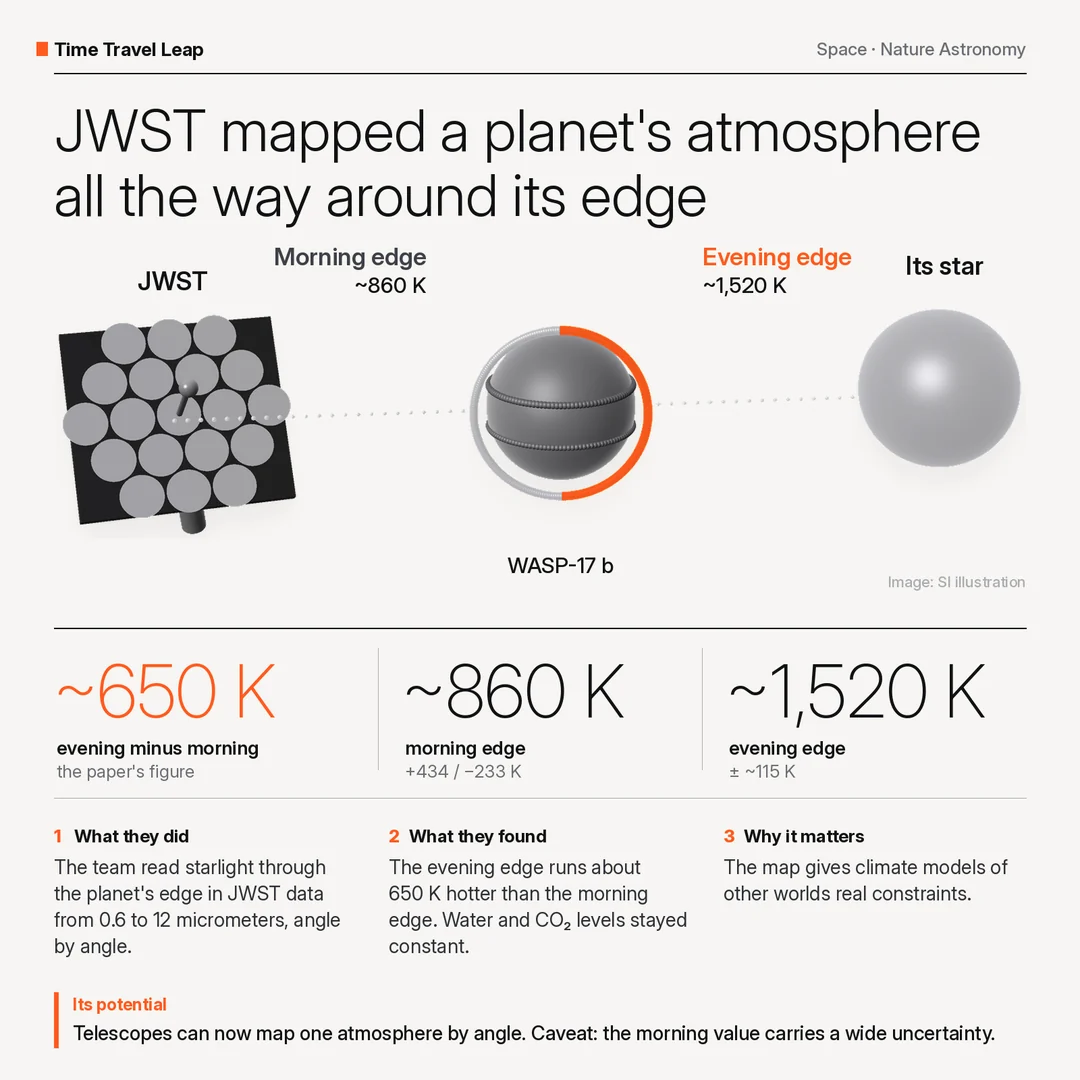
Infographic: a gold hexagonal telescope mirror labeled JWST, the planet WASP-17 b with a ring around its edge (gray on the morning side, orange on the evening side) and its star. Panels explain that the team read starlight through the planet's edge in JWST data from 0.6 to 12 micrometers, that the evening edge runs about 650 K hotter than the morning edge while water and carbon dioxide levels stayed constant and that the map gives climate models real constraints. Cards: about 650 K difference, morning edge about 860 K (plus 434 or minus 233 K), evening edge about 1,520 K (plus or minus about 115 K). Banner: the morning value carries a wide uncertainty. Source: Nature Astronomy, Oct. 14, 2026.

The evening side of the hot Jupiter WASP-17 b turned out to be about 650 K hotter than its morning side. (Image: SI illustration)

Nature Astronomy · Oct. 14, 2026

Longevity

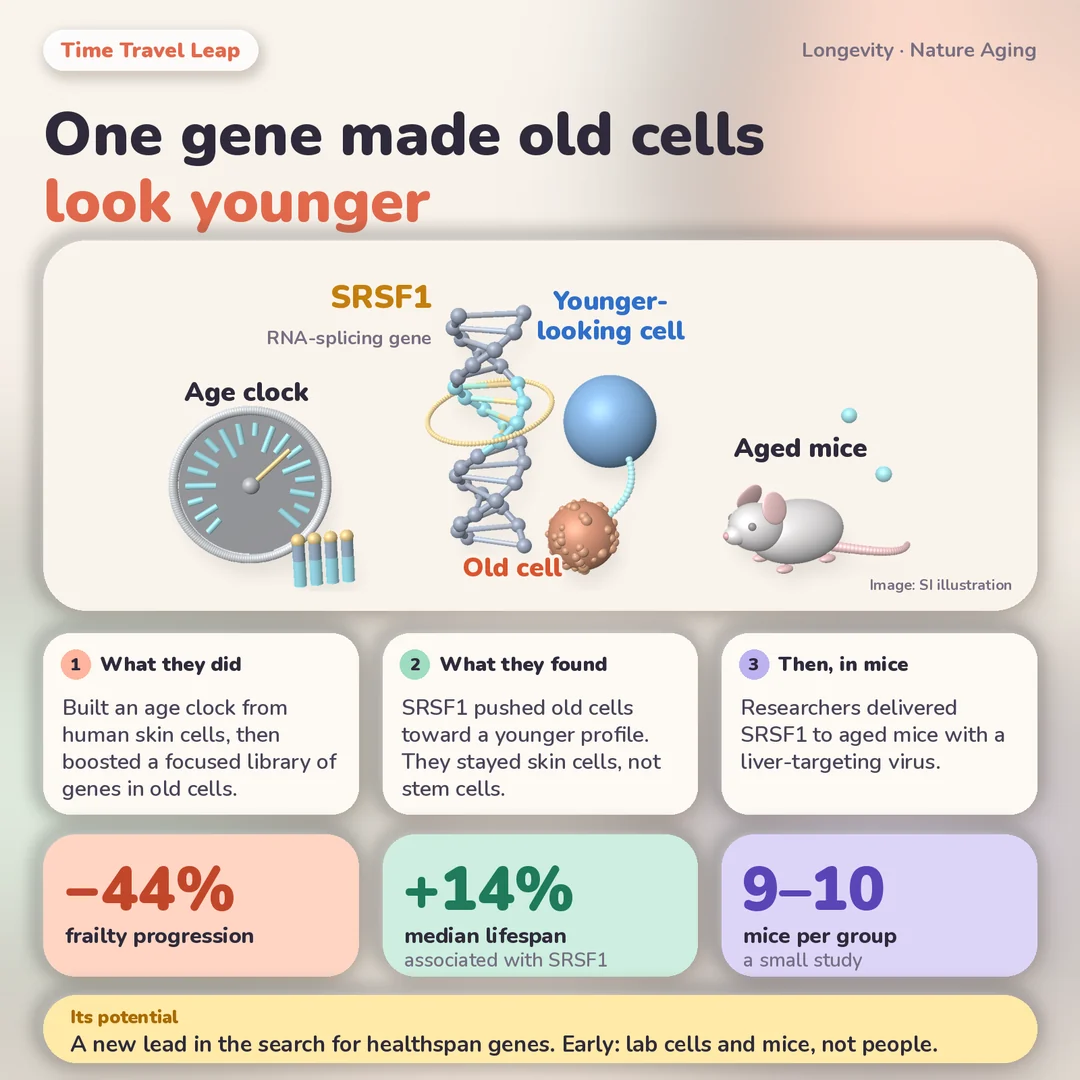
One gene made old cells look younger

Infographic: an age-clock gauge beside test tubes; a DNA strand with a glowing section labeled SRSF1, an RNA-splicing gene; an old orange cell linked to a younger-looking blue cell; and a mouse labeled aged mice. Panels explain that researchers built an age clock from human skin cells and boosted a focused library of genes in old cells, that SRSF1 pushed old cells toward a younger profile while they stayed skin cells and that researchers delivered SRSF1 to aged mice with a liver-targeting virus. Results: frailty progression down 44 percent, median lifespan up 14 percent (associated with SRSF1), nine to 10 mice per group. Banner: early result in lab cells and mice, not people. Source: Nature Aging, Oct. 14, 2026.

In a small study of aged mice, it slowed frailty and was linked to longer life. It is an early result. (Image: SI illustration)

Nature Aging 6(10), 2057–2073 · Oct. 14, 2026