
A temporary liquid helps build better solar cells
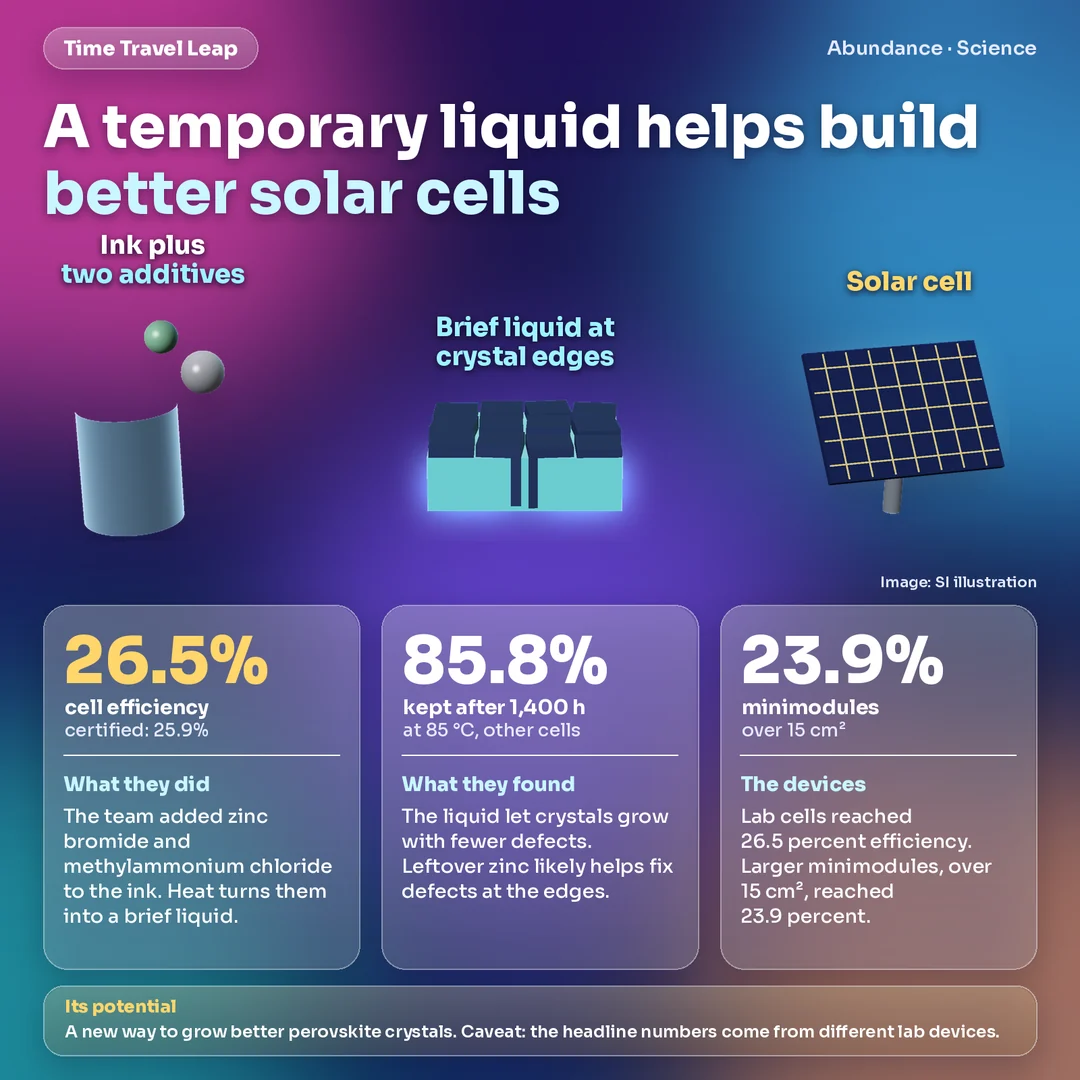
A short-lived liquid that forms between growing crystals pushed perovskite solar cells to 26.5 percent efficiency, a step toward abundant solar power. (Image: SI illustration)
Sometimes the trick to building a better crystal is to let it melt, briefly, in exactly the right places. That is the idea behind a new paper in Science, published in print on Oct. 8, 2026.
What the researchers did
UC San Diego and Sungkyunkwan University in Korea led the work, with the Korea Research Institute of Chemical Technology, MIT and Princeton, Argonne National Laboratory and others. The team focused on perovskites, materials being developed for next-generation solar cells.
They added two ingredients, zinc bromide and methylammonium chloride, to the perovskite ink. When the team heats the film, the two form a eutectic: a mixture that melts at a lower temperature than either part alone. That liquid forms for a short time at the boundaries between growing crystals, then the methylammonium chloride evaporates.
What they found
Using nanoprobe X-ray imaging, the team watched the mixture melt locally at the crystal boundaries. This let the crystals grow with fewer defects inside them. The zinc left behind gathers at the boundaries, and it likely helps fix electronic defects there.
The results were strong. Solar cells reached 26.5 percent efficiency, with 25.9 percent independently certified. Minimodules larger than 15 square centimeters reached 23.9 percent.
The team tested stability on a separate set of small cells that started at 24.1 percent efficiency. After 1,400 hours of continuous operation at 85°C, they kept 85.8 percent of their efficiency. The same approach also produced LEDs with 26.1 percent external quantum efficiency.
Its potential
Perovskites can be made from solutions, or inks, which UC San Diego says could allow simpler, lower-energy manufacturing than silicon. This method adds a new tool for controlling how the crystals form, and it works for both solar cells and LEDs. Together that is a step toward abundant solar power.
The limits
The headline numbers come from different devices. The 26.5 percent figure (25.9 percent certified) comes from the main solar cells. The larger minimodules, over 15 square centimeters, reached 23.9 percent. The heat-stability result comes from separate small cells with a different hole-transport layer that started at 24.1 percent. Do not read them as one device that does everything at once.
The paper also does not show that this method is cheap. Perovskites in general are seen as having potential for low-cost, high-efficiency solar cells, but cost is not a result of this study. And this study reports lab cells and minimodules, not commercial panels.
What the study does show is a clever bit of chemistry: melt the boundaries for a moment, and the crystals come out better.
Get the week's top 5 stories: Subscribe free.
Sources
- Yoo J.J., Dolan C.J., … deQuilettes D.W., Fenning D.P., Shin S.S. et al. (29 authors) “Volatile eutectics to tailor crystallization for perovskite optoelectronics.” Science 394(6820), 228–233. Published October 8, 2026 (in print). DOI: https://doi.org/10.1126/science.aeb4554
- UC San Diego news release: https://today.ucsd.edu/story/a-temporary-melting-liquid-could-help-build-better-perovskite-solar-cells-and-leds
Sources last checked Oct. 18, 2026.
Follow Time Travel Leap on X for the next post.