Category

Abundance

Abundance: short, sourced explainers from Time Travel Leap.

Abundance
Recycling old magnets for rare earths, with a modeled fraction of the climate cost

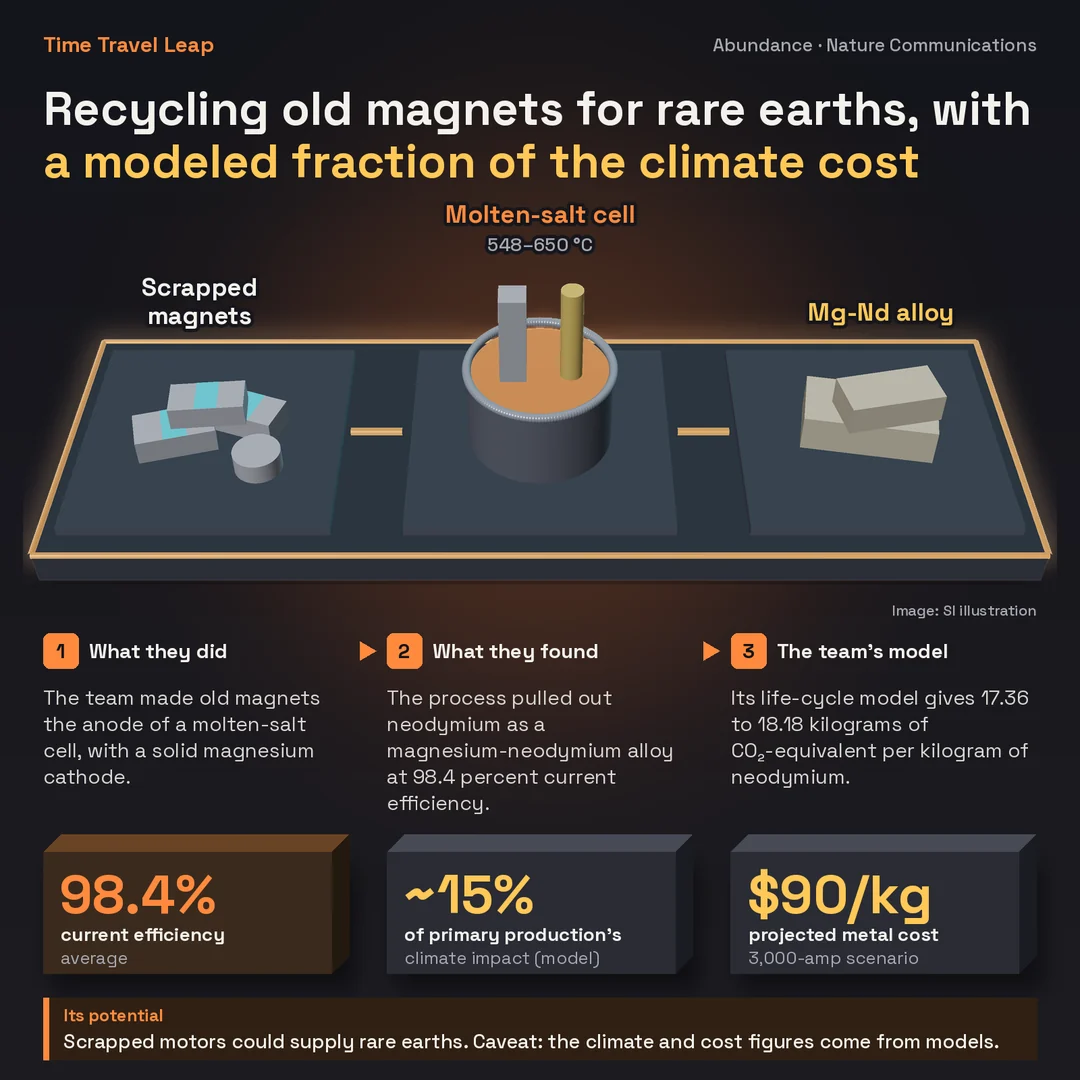
Infographic: a display table that runs left to right from a pile of scrapped magnets to a molten-salt cell at 548 to 650 degrees Celsius with two electrodes in glowing orange salt and ingots labeled Mg-Nd alloy. Panels explain that the team made old magnets the anode of a molten-salt cell with a magnesium cathode, that the process pulled out neodymium as a magnesium-neodymium alloy at 98.4 percent current efficiency and that the team's life-cycle model gives 17.36 to 18.18 kilograms of CO2-equivalent per kilogram of neodymium. Cards: 98.4 percent average current efficiency, about 15 percent of primary production's climate impact (model), $90 per kilogram projected cost in a 3,000-amp scenario. Banner: the climate and cost figures come from models. Source: Nature Communications, Oct. 13, 2026.

A new process recovers neodymium from scrapped magnets. A life-cycle model puts its climate impact at about 15 percent of producing new neodymium from ore. (Image: SI illustration)

Nature Communications · Oct. 13, 2026

Abundance

A crystal-packed membrane lets CO2 race through

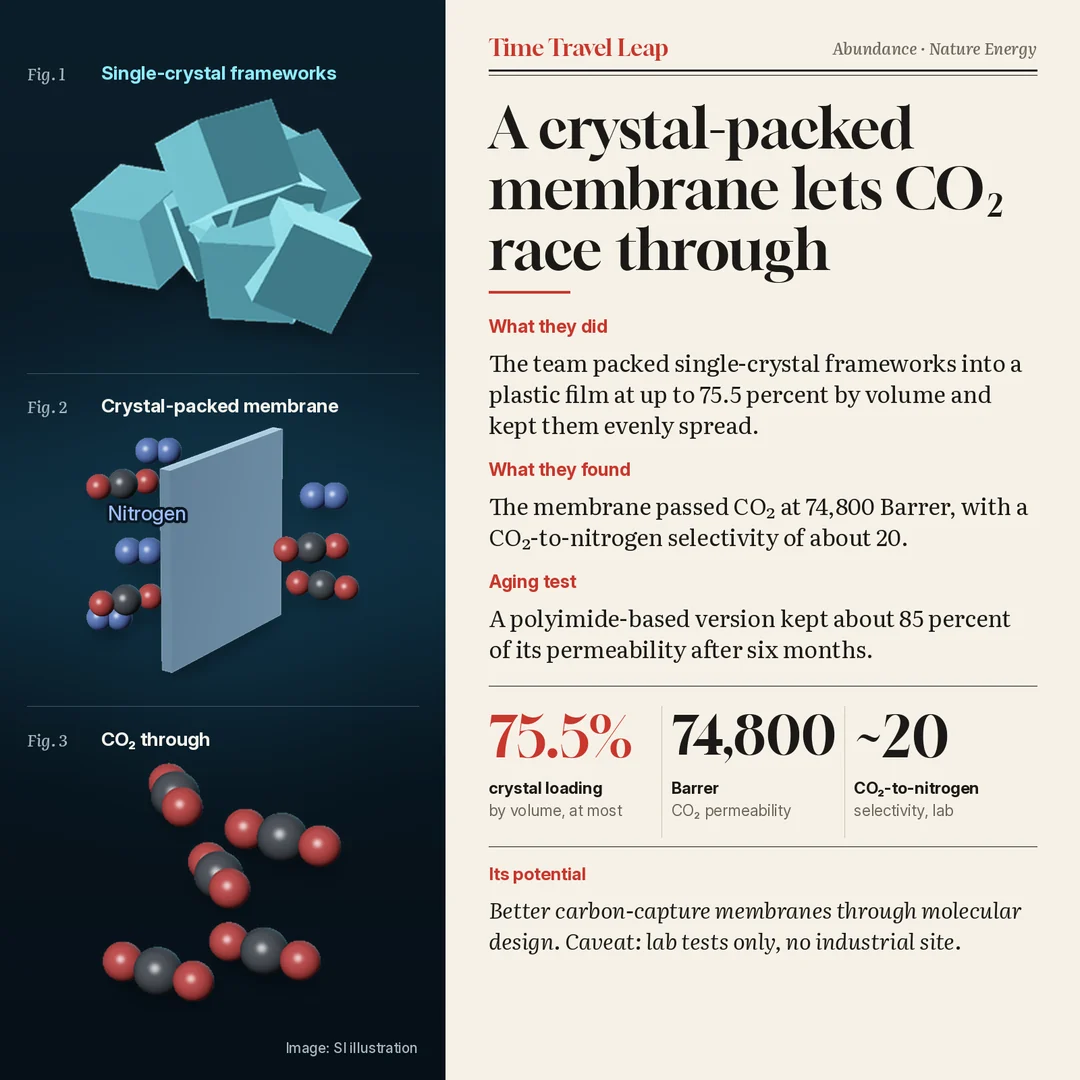
Infographic: three stacked figures beside the text show a cluster of cyan single-crystal frameworks; a translucent crystal-packed membrane with mostly nitrogen molecules held back on one side, and carbon dioxide molecules plus one nitrogen molecule on the other; and carbon dioxide molecules that came through. Panels explain that the team packed the crystals into a plastic film at up to 75.5 percent by volume, that the membrane passed CO2 at 74,800 Barrer with a CO2-to-nitrogen selectivity of about 20 and that a polyimide-based version kept about 85 percent of its permeability after six months. Cards: 75.5 percent crystal loading at most, 74,800 Barrer, selectivity about 20 in lab tests. Banner: lab tests only, no industrial site. Source: Nature Energy, Oct. 7, 2026.

A plastic film loaded with up to 75.5 percent (by volume) single-crystal organic frameworks let carbon dioxide pass very fast in lab tests. (Image: SI illustration)

Nature Energy · Oct. 7, 2026

Abundance

A temporary liquid helps build better solar cells

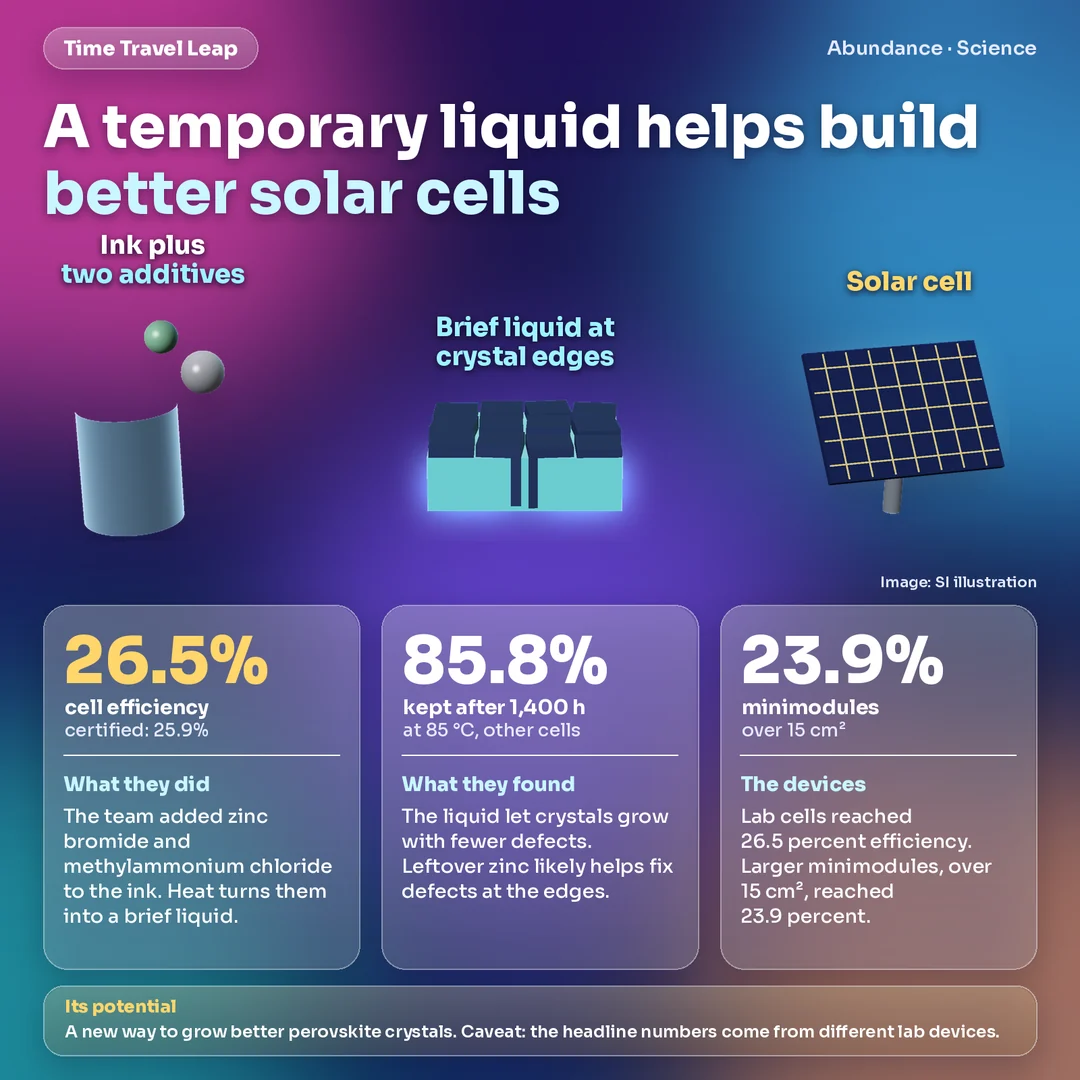
Infographic: a beaker of perovskite ink with two additive spheres, a block of crystal grains with glowing liquid at their edges and a solar cell. Panels explain that the team added zinc bromide and methylammonium chloride to the ink, that the brief liquid let crystals grow with fewer defects and that lab cells reached 26.5 percent efficiency while larger minimodules reached 23.9 percent. Cards: 26.5 percent cell efficiency (25.9 percent independently certified), 85.8 percent kept after 1,400 hours at 85 degrees Celsius in separate cells, 23.9 percent for minimodules over 15 square centimeters. Banner: the headline numbers come from different lab devices. Source: Science, Oct. 8, 2026.

A short-lived liquid that forms between growing crystals pushed perovskite solar cells to 26.5 percent efficiency, a step toward abundant solar power. (Image: SI illustration)

Science 394(6820), 228–233 · Oct. 8, 2026 (in print)