
Recycling old magnets for rare earths, with a modeled fraction of the climate cost
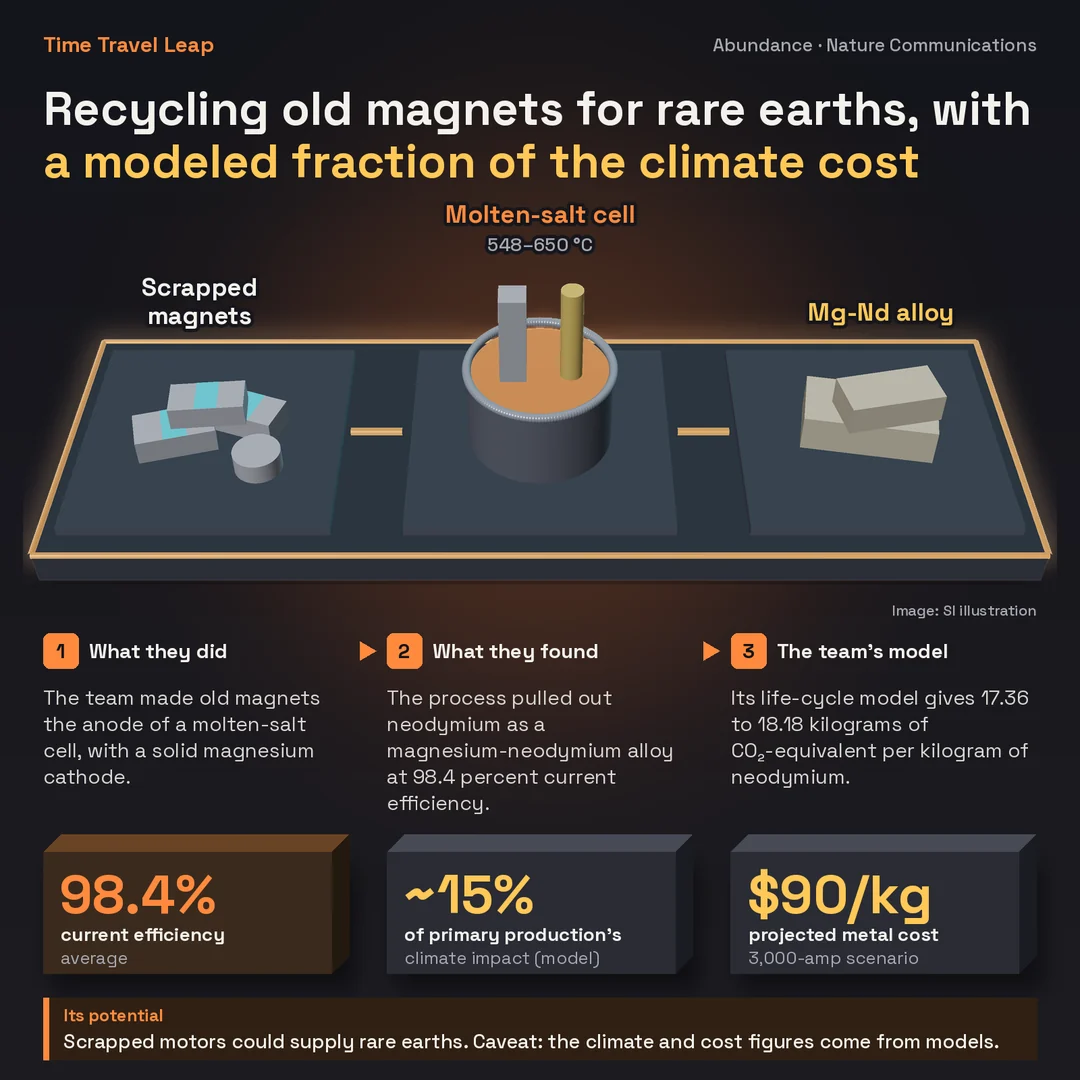
A new process recovers neodymium from scrapped magnets. A life-cycle model puts its climate impact at about 15 percent of producing new neodymium from ore. (Image: SI illustration)
Where will the next supply of rare earths come from? A team led from the University of Science and Technology Beijing suggests one answer: old magnets. Their paper appeared in Nature Communications on Oct. 13, 2026.
What the researchers did
Neodymium magnets power electric-vehicle motors and wind turbines. The team set out to pull the neodymium back out of magnets at the end of their life.
They made the old magnets the anode of a molten-salt electrolysis cell, with a solid magnesium cathode. The process selectively dissolves the neodymium and collects it as a liquid magnesium–neodymium alloy. The cell ran at 548 to 650 °C.
What they found
The process ran with an average current efficiency of 98.4 percent, meaning almost all of the electric current went into the intended reaction.
The team also modeled the process. Their life-cycle model puts its climate impact at 17.36 to 18.18 kg of CO2-equivalent per kilogram of neodymium, about 15 percent of that of primary production.
They also modeled costs. In a scaled-up 3,000-amp scenario, the projected cost of neodymium metal is 90 US dollars per kilogram, about one-third below its sales price.
Its potential
If results like these hold up at scale, scrapped motors and turbines could become a source of rare earths. That would turn a waste stream into supply for the clean-energy industry.
The limits
The climate figure comes from a life-cycle model, and the cost figure is a projected scale-up scenario. Neither is a measured result from a working plant.
The process yields a magnesium–neodymium alloy, not pure neodymium.
The paper is open access, but this explainer draws on its abstract and author details. It does not draw on the full text.
So the fair summary is an encouraging one with clear caveats: a recycling process recovered neodymium efficiently in the lab, and models suggest it could be far cleaner than producing it from ore.
Get the week's top 5 stories: Subscribe free.
Sources
- Wei J., He W., Liu Q. (equal contribution), … Zhu H., Jiao S. (corresponding: Lu X., Jiao S.) “Securing critical rare-earth supply through end-of-life NdFeB magnets recycling via molten salt electrolysis with consumable Mg-cathode.” Nature Communications (2026). Published October 13, 2026. DOI: https://doi.org/10.1038/s41467-026-78305-2
Sources last checked Oct. 18, 2026.
Follow Time Travel Leap on X for the next post.