
A crystal-packed membrane lets CO2 race through
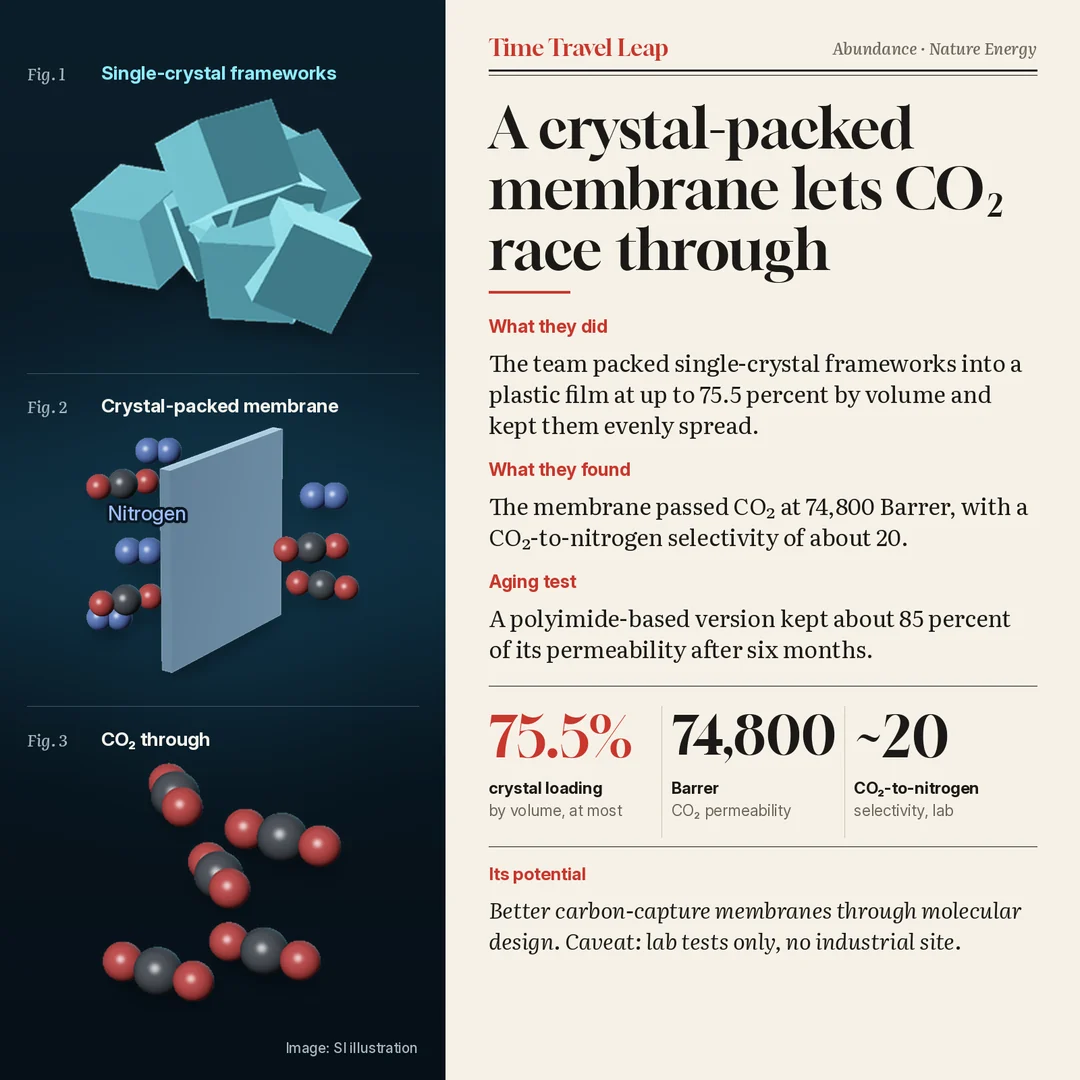
A plastic film loaded with up to 75.5 percent (by volume) single-crystal organic frameworks let carbon dioxide pass very fast in lab tests. (Image: SI illustration)
Can a thin film pull carbon dioxide out of a gas mixture quickly? A team led from Tianjin University, working with colleagues at EPFL and other institutions, built one that lets CO2 through very fast. Their paper appeared in Nature Energy on Oct. 7, 2026.
What the researchers did
Membranes are one approach to carbon capture. To work well, they need materials that let gas through quickly and selectively, stay stable over time and lend themselves to processing at scale. One idea is to mix porous crystals into a plastic film, so gas can travel through the crystals' tiny channels. The trouble is that the crystals usually clump together at high loadings.
This team used weak interactions between the materials to embed single-crystal covalent organic frameworks at up to 75.5 percent by volume, while keeping them evenly spread. The gas then travels mainly through the crystals' own channels.
What they found
The membrane passed CO2 at 74,800 Barrer, a standard unit of gas permeability, while keeping a CO2-to-nitrogen selectivity of about 20.
The team also tested how the material ages. A polyimide-based version kept about 85 percent of its starting permeability after six months at room temperature.
Its potential
Materials designed at the molecular level could lead to better membranes for carbon capture. This study shows one way to pack far more crystal into a membrane without the usual clumping.
The limits
These are lab gas-separation results. The study did not test the membrane at an industrial site.
A selectivity of about 20 is moderate. The six-month aging result applies to the polyimide-based version, not necessarily to every membrane in the study.
The paper sits behind a paywall. This explainer draws on its abstract, figure titles and author details. It does not draw on the full text.
So the fair summary is a technical step with an open question: a crystal-packed membrane let CO2 race through in the lab, and how it performs outside the lab remains an open question.
Get the week's top 5 stories: Subscribe free.
Sources
- Ma H., Guo S. (equal first), … He G., Jiang Z. (corresponding) “All-organic mixed-matrix membranes with single-crystal covalent organic frameworks for carbon capture.” Nature Energy (2026). Published October 7, 2026. DOI: https://doi.org/10.1038/s41560-026-02149-9
Sources last checked Oct. 18, 2026.
Follow Time Travel Leap on X for the next post.