
Wood, wheat straw and sunlight turned seawater into drinking water
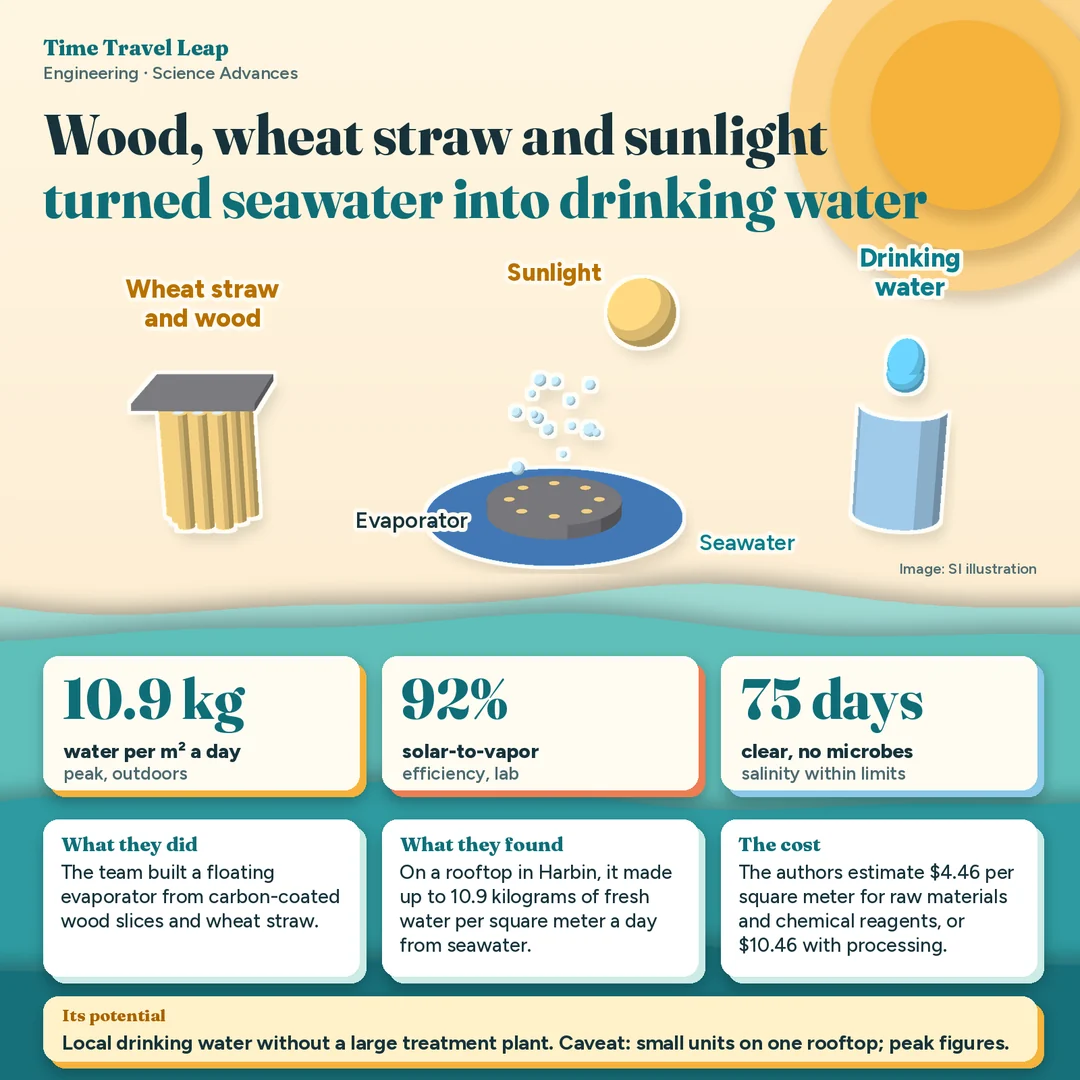
A small rooftop purifier built from plant materials made drinkable water from seawater for 75 days. It is a field test, not a plant. (Image: SI illustration)
What if drinking water could come from seawater, sunlight and plant scraps? A team led from Northeast Forestry University in Harbin, China, and the University of Texas at Austin built a small device to test the idea. Their paper appeared in Science Advances on Oct. 14, 2026.
What the researchers did
Solar evaporators float on water, soak up sunlight and turn it into heat. Clean water evaporates, and the device collects it.
This team built one entirely from plant materials. Ultrathin wood slices coated with carbon black absorb the light. Upright wheat straws filled with wood nanocellulose wick water up to the surface fast.
What they found
In the lab it evaporated up to 3.2 kg of water per square meter per hour, or 2.6 kg on seawater. The team calculated its solar-to-vapor efficiency at 92 percent.
Outdoors, on a rooftop in Harbin, the assembled device produced up to 10.9 kg of fresh water per square meter per day from seawater, under sunlight at 0.5 to 0.9 of full strength.
Over 75 days of use, the harvested water stayed clear, transparent and free from microbial contamination. Its salinity stayed within WHO and EPA drinking-water limits.
The authors estimate the cost at $4.46 per square meter for raw materials and chemical reagents. By their estimate, that rises to $10.46 per square meter once they count processing steps such as freeze-drying and water-bath heating.
Its potential
Small solar purifiers made from renewable plant materials point toward water that can be produced locally, close to where people need it, without a large plant.
The limits
This was a field test with small units, about 5.5 cm across, on one rooftop. The outdoor run took place from Aug. 3 to Oct. 17, 2022. The largest demonstration had about 1,250 square centimeters of evaporation area, which is far from a commercial plant.
The "up to" figures are peak values, not daily averages. The cost figures are the authors' own estimates, not market prices.
The paper is open access, and we read its full text for this explainer.
So the honest headline is a promising one with clear limits: a plant-based purifier made drinkable water from seawater for 75 days, at a small scale.
Get the week's top 5 stories: Subscribe free.
Sources
- Han X., Lei C., Miao M. (equal contribution), … Chen W., Yu G. (corresponding) “Sustainable solar water purification: Exploring the structural advantages of higher plants.” Science Advances 12(42), eaeh3059. Published October 14, 2026. DOI: https://doi.org/10.1126/sciadv.aeh3059
Sources last checked Oct. 18, 2026.
Follow Time Travel Leap on X for the next post.