
MonoRace, a one-camera drone, beat former world champions
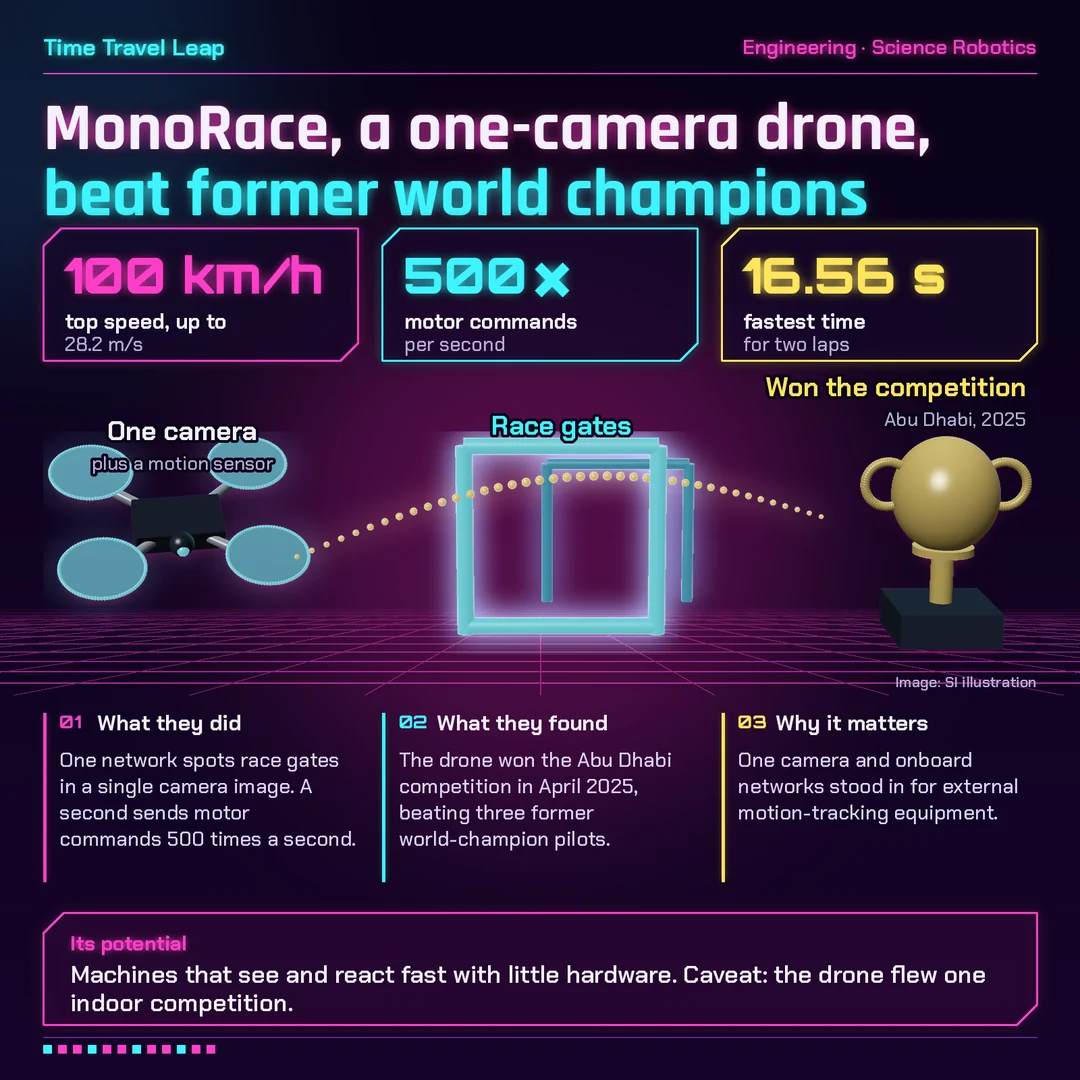
A racing drone that sees with a single camera and a motion sensor won an international competition, beating three former world-champion human pilots. (Image: SI illustration)
How little does a machine need to fly at champion level? According to a new paper in Science Robotics, published Oct. 14, 2026, the answer is one camera, one motion sensor and some well-trained neural networks.
What the researchers did
The team behind MonoRace works in the Control & Operation group at Delft University of Technology, in the MAVLab of the Faculty of Aerospace Engineering. The race drone, supplied by the competition organizers, carries a single rolling-shutter camera and an inertial measurement unit, or IMU, a motion sensor that measures how a craft accelerates and rotates. There is no external motion-tracking system watching from the walls.
A neural network looks at the camera image and picks out the race gates. A second, small control network runs on the flight controller itself, 500 times a second, and sends commands directly to the motors.
What they found
The team put the drone to the test at the Abu Dhabi Autonomous Drone Racing Competition 2025, held in an indoor hall on April 11–12, 2025. It won. In a direct knockout tournament it beat every competing Super Intelligence team and three former world-champion human pilots.
It flew at speeds of up to 100 km/h, with a top speed of 28.2 meters per second. Its fastest time was 16.56 seconds for two laps.
Its potential
This is a clear case of Super Intelligence and robotics coming together. A single camera plus neural networks stood in for external tracking equipment, and the result held up against three former world-champion pilots in a real competition. Robots that can see and react this fast with so little hardware point toward more capable machine autonomy.
The limits
This was one competition, flown indoors on a race course with gates. Winning a race is a narrow, well-defined task, and the paper shows what this system did there, not how it would handle the open world.
There is also a small wording choice. The paper calls the human opponents world-champion pilots, while TU Delft's release calls them former world champions. Both are defensible, and we use "former" as the safer description.
Still, the core result is striking: in a physical sport, a drone with one eye and fast onboard networks outflew human champions.
Get the week's top 5 stories: Subscribe free.
Sources
- Bahnam S.A., Ferede R. (equal first authors), Blaha T.M., Lang A.E., Lucassen E., Missinne Q., Verraest A.E.C., De Wagter C., de Croon G.C.H.E. “MonoRace: Robust monocular AI for champion-level drone racing.” Science Robotics 11(119), eaee9250. Published October 14, 2026. DOI: https://doi.org/10.1126/scirobotics.aee9250
- TU Delft news release: https://www.tudelft.nl/en/2026/tu-delft/the-science-behind-worlds-fastest-autonomous-racing-drone
Sources last checked Oct. 18, 2026.
Follow Time Travel Leap on X for the next post.