
Light on about 20 neurons triggered a learned movement
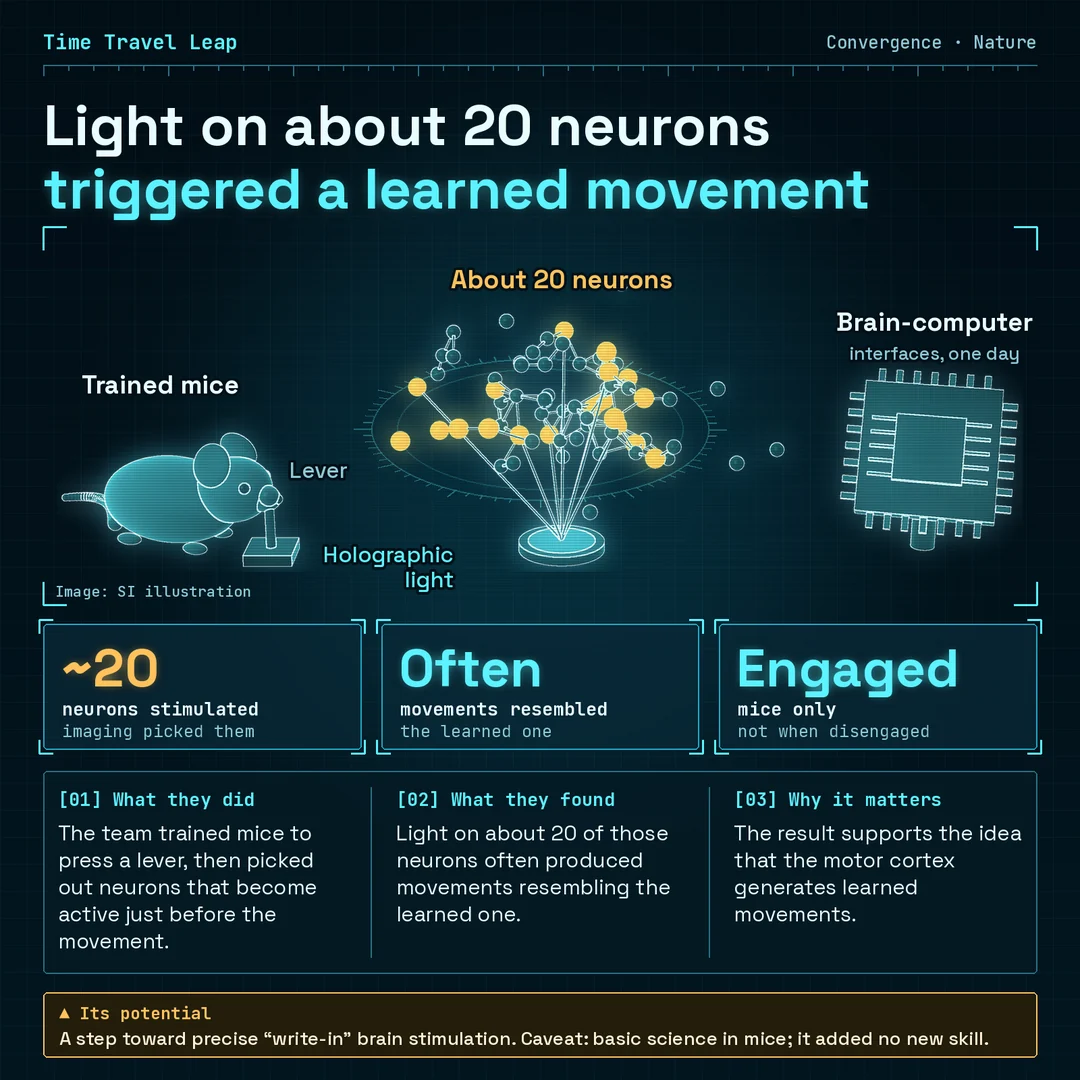
In mice, stimulating a small, precisely chosen group of brain cells often produced movements resembling a skill the animals had already learned. (Image: SI illustration)
How many brain cells does it take to set off a learned movement? In mice, about 20 well-chosen ones can be enough, according to a new paper in Nature, published online Oct. 14, 2026.
What the researchers did
The study comes from the Komiyama lab at UC San Diego. The researchers trained mice to press a lever, then watched neurons in the primary motor cortex, a brain region that helps plan and carry out voluntary movements, using two-photon imaging.
They looked for the neurons whose activity starts just before the movement. Then they used holographic optogenetics to stimulate those neurons. In optogenetics, scientists genetically make neurons sensitive to light so that light can switch them on; the holographic version shapes laser light so it targets precisely selected cells.
What they found
Briefly stimulating about 20 of these neurons often produced movements resembling the learned one. In many cases, senior author Takaki Komiyama says, it produced the learned movement itself. The stimulation also recreated the learned pattern of activity in other neurons of the motor cortex.
There was an important twist. The effect appeared only when the mouse was engaged in the task. In mice that were not engaged, stimulation did not have this effect.
That supports the idea that the motor cortex actively generates learned movements, rather than just reflecting them.
Its potential
UC San Diego describes the work as both reading brain activity and writing patterns into it, down to individual cells. It is a step toward precise "write-in" stimulation: light on about 20 cells triggered a skill the mouse had already learned. The UC San Diego team notes that this kind of research could one day help as scientists develop brain-computer interfaces.
The limits
This is basic science in mice. The animals learned the lever task the normal way, and the stimulation triggered what they already knew. The researchers uploaded nothing and put no new skill into the brain.
The movements also did not appear in every trial, and they resembled the learned movement rather than always matching it. And because the effect depended on the mouse being engaged, the result depends on what the animal is doing at the time.
The paper itself sits behind a paywall. This explainer draws on its abstract, figure titles and author details, and on UC San Diego's news release. It does not draw on the full text.
A note on the team: co-first author An Wu died in 2023. UC San Diego says she was an assistant project scientist in the Komiyama lab who initiated this research. The paper lists her as deceased, and the authors dedicated it "to our friend and colleague, A.W."
The result is still a striking one. A tiny, carefully chosen group of cells, lit at the right moment, was enough to set a learned movement in motion.
Get the week's top 5 stories: Subscribe free.
Sources
- Chen Q., Wu A. (equal first authors), Yu B., Chae S., Tan Z., Ramot A., Aljadeff J., Komiyama T. “Targeted stimulation of motor cortex ensembles drives learned movements.” Nature (online ahead of print; no volume or pages yet). Published October 14, 2026. DOI: https://doi.org/10.1038/s41586-026-11174-3
- UC San Diego news release: https://today.ucsd.edu/story/neurobiologists-trigger-learned-movements-by-activating-just-20-brain-cells
Sources last checked Oct. 18, 2026.
Follow Time Travel Leap on X for the next post.