
JWST mapped a planet's atmosphere all the way around its edge
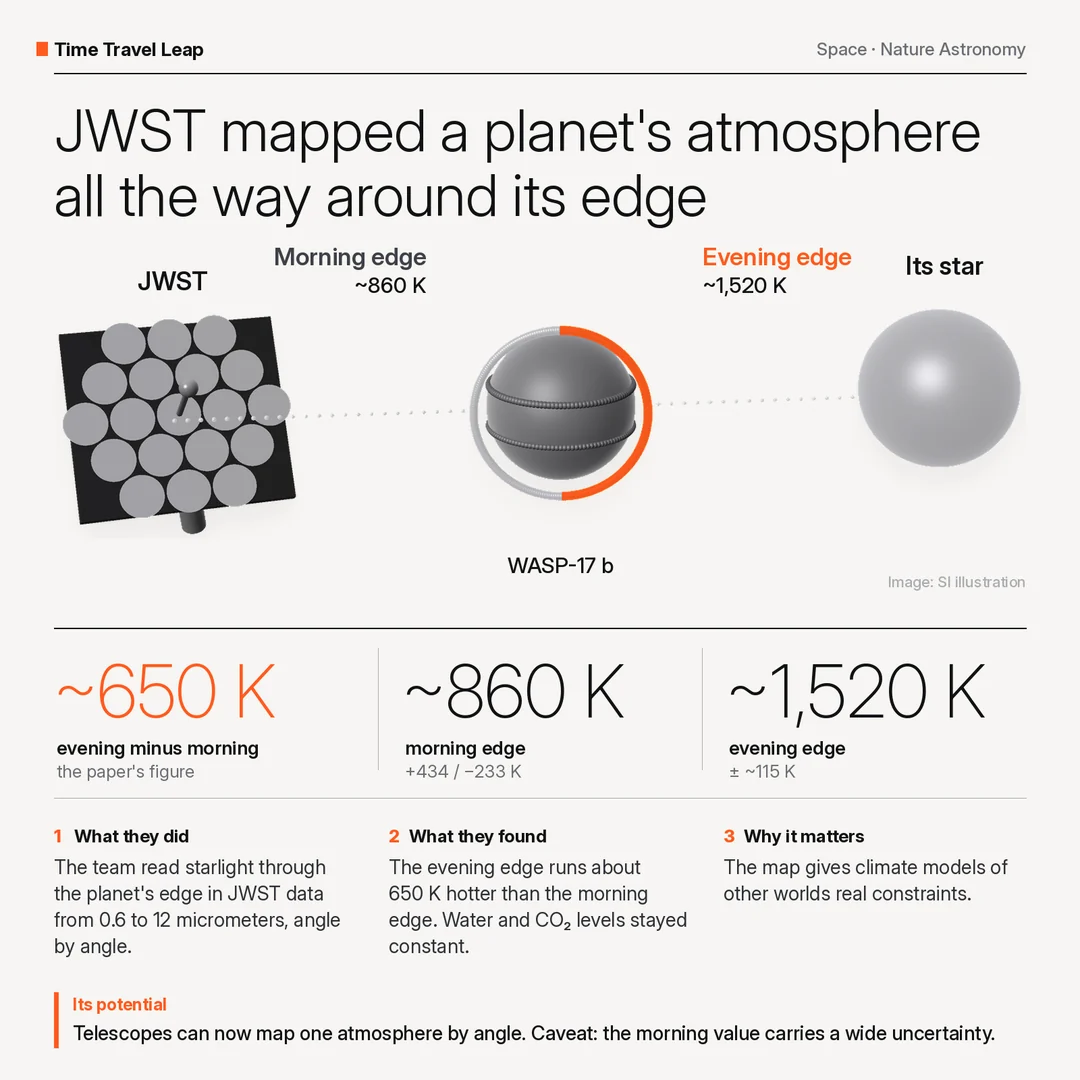
The evening side of the hot Jupiter WASP-17 b turned out to be about 650 K hotter than its morning side. (Image: SI illustration)
Imagine reading a weather map of a world you can never visit. A new paper in Nature Astronomy, published online and open access on Oct. 14, 2026, gets a step closer to that for a giant planet called WASP-17 b.
What the researchers did
The study was co-led by Cornell University and the University of Bristol, with partners including Oxford, Johns Hopkins, MIT, Université de Montréal, NASA Goddard, the Space Telescope Science Institute and NASA's Jet Propulsion Laboratory.
WASP-17 b is a hot Jupiter. When it passes in front of its star, starlight shines through the thin ring of atmosphere at the planet's edge, called the limb. The team used a new method called "transmission strings" on James Webb Space Telescope data, covering wavelengths from 0.6 to 12 micrometers across three of its instruments.
Instead of treating that ring as one average, they mapped it by angle: east to west, and from the equator to the poles.
What they found
The two sides of the planet's edge are very different. The evening side is about 650 K hotter than the morning side. The morning edge comes out at roughly 860 K and the evening edge at roughly 1,520 K.
Not everything changed, though. Levels of water and carbon dioxide stayed constant all the way around the edge.
Its potential
Those measurements give real constraints for the computer models scientists use to understand the climates of other worlds. More broadly, telescopes like JWST keep raising the level of detail we can see on planets around other stars. A map of a single atmosphere by angle is a new kind of picture.
The limits
The morning temperature carries a large uncertainty: about 858 K, give or take several hundred degrees (plus 434 or minus 233 K). The evening value is much tighter, at about 1,522 K, plus or minus around 115 K. The difference of about 650 K is the paper's own figure, and because of the wide morning range the true gap could be noticeably smaller or larger.
This is also one planet. WASP-17 b is a hot Jupiter, a type of world very unlike Earth, and one map does not tell us how common this pattern is.
Still, it is a remarkable view: the edge of an alien atmosphere, read slice by slice, with a telescope.
Get the week's top 5 stories: Subscribe free.
Sources
- Alderson L., Wakeford H.R., Grant D., … Kataria T. et al. (21 authors) “A spatial map of the atmospheric limb of a hot Jupiter.” Nature Astronomy (online; open access; no volume yet). Published October 14, 2026. DOI: https://doi.org/10.1038/s41550-026-02986-4
- University of Bristol news release: https://www.bristol.ac.uk/news/2026/october/trailblazing-technique-uncovers-real-shape-of-scorching-hot-exoplanet-atmosphere.html
Sources last checked Oct. 18, 2026.
Follow Time Travel Leap on X for the next post.