
One gene made old cells look younger
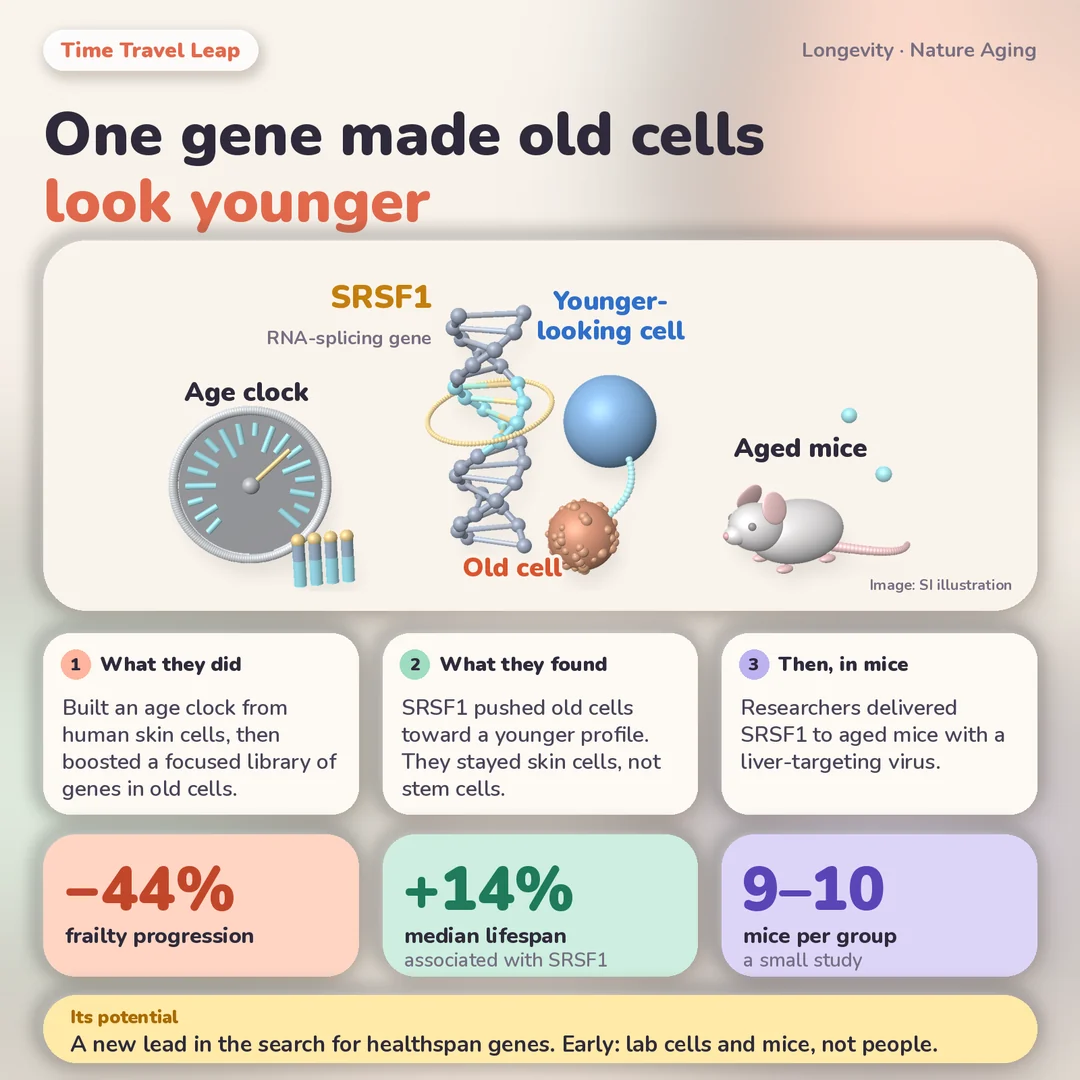
In a small study of aged mice, it slowed frailty and was linked to longer life. It is an early result. (Image: SI illustration)
Can a single gene push an old cell back toward youth? A team led by George Church's lab at the Wyss Institute and Harvard Medical School, working with colleagues at CIC bioGUNE in Spain, went looking for one. Their paper appeared in Nature Aging on Oct. 14, 2026.
What the researchers did
First, the team built an "age clock" from the gene activity of human skin cells. Think of it as a way to read how old a cell looks from which of its genes are busy.
Then they used that clock as a scoreboard. They overexpressed a focused library of candidate genes in old cells and watched which ones moved the cells back toward a young profile.
What they found
One gene stood out: SRSF1, a gene that controls RNA splicing. It pushed old cells toward a younger-looking gene-activity profile, and it did so without turning them into stem cells. The cells kept their identity as skin cells.
The team then moved to animals. In aged mice, the team delivered SRSF1 with a liver-targeting virus, and it cut frailty progression by 44 percent. It was also associated with a 14 percent longer median lifespan.
The paper words that second result carefully on purpose. The paper reports the longer lifespan as "associated with" SRSF1, which is a weaker statement than saying the gene caused it.
Its potential
George Church says his lab's long-standing goal is to find genes that could extend human healthspan, the years of healthy life. This study adds a new name to that search, and it shows one way to find candidates: let an age clock score many genes and see which ones turn the dial back.
The limits
This is an early result from a small study in mice. Each group had only nine to 10 mice, which is not many, and researchers need to repeat small studies in larger ones before anyone can lean on them. The animal results come from mice, not people.
The paper itself sits behind a paywall. This explainer draws on its abstract, figure titles and author details, and on the Wyss Institute's news release. It does not draw on the full text.
So the honest headline is a hopeful one with an asterisk: one gene made old cells look younger, and in a small group of aged mice it slowed frailty. Whether any of that carries over to people is a question this study does not answer.
Get the week's top 5 stories: Subscribe free.
Sources
- Plesa A.M., Jung S. (co-first authors), … del Sol A., Church G.M. et al. “Transcriptomic reprogramming screen identifies SRSF1 as a regulator of aging.” Nature Aging 6(10), 2057–2073. Published October 14, 2026. DOI: https://doi.org/10.1038/s43587-026-01234-8
- Wyss Institute news release: https://wyss.harvard.edu/news/reversing-age-by-reprogramming-gene-expression-networks/
Sources last checked Oct. 18, 2026.
Follow Time Travel Leap on X for the next post.