
The LACE framework designs its own problem-solving algorithms
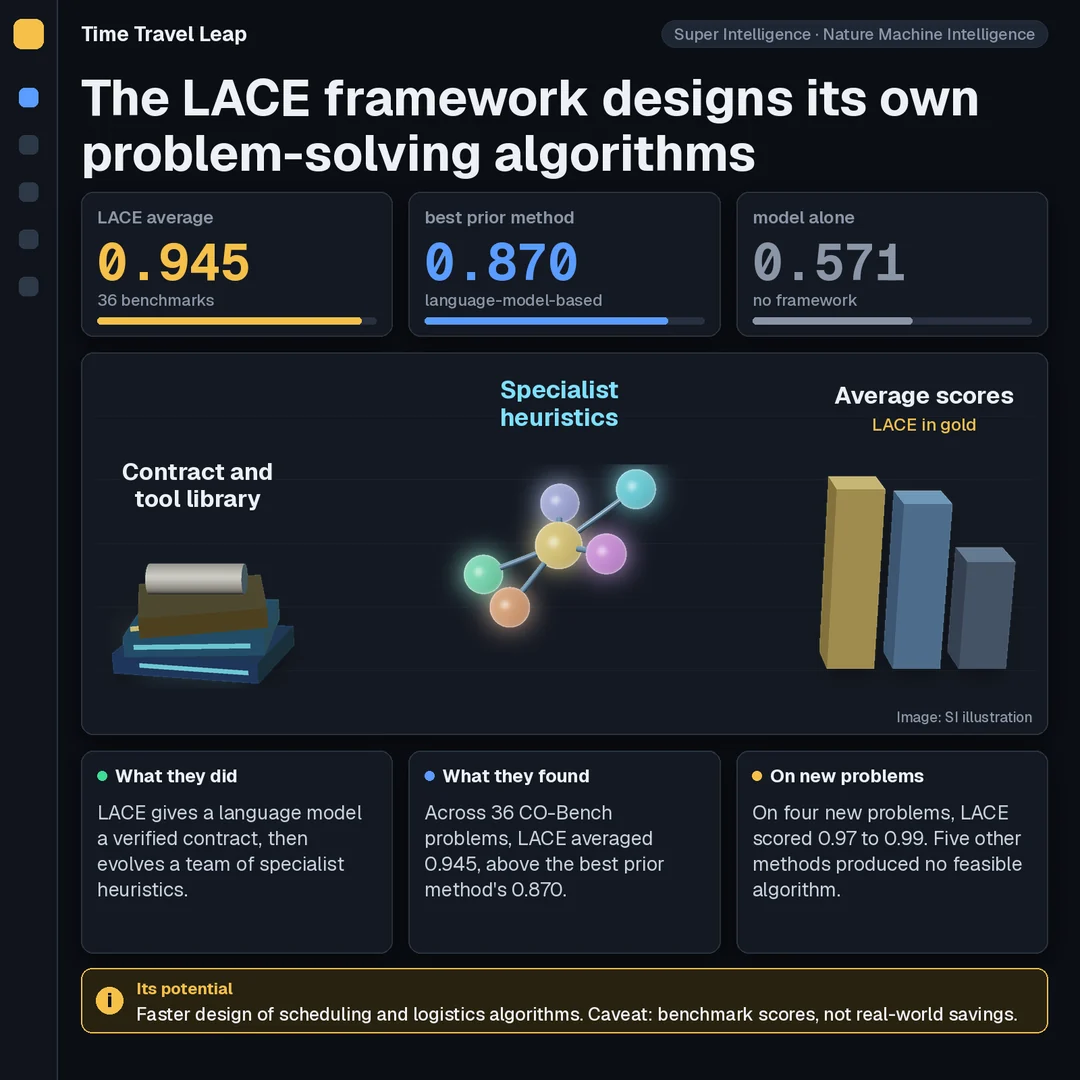
LACE outscored other Super Intelligence methods on average across 36 classic optimization benchmarks. The scores are benchmark results, not real-world savings. (Image: SI illustration)
Can a Super Intelligence system invent the shortcuts that experts spend months crafting? A team led from Nanyang Technological University in Singapore built a framework, called LACE, that tries. Their paper appeared in Nature Machine Intelligence on Oct. 1, 2026.
What the researchers did
Optimization problems of this kind underpin decisions in manufacturing, logistics, healthcare operations and energy management. Designing good shortcuts for each new variant, called heuristics, normally takes deep expertise and months of iteration.
LACE first builds a verified problem contract for a large language model to work within: the input format, the output format and a library of tools. It then evolves a portfolio of complementary specialist heuristics, working under time limits. Each specialist is good at different cases, and together they cover more ground.
What they found
Across 36 classic problems in a benchmark called CO-Bench, LACE scored 0.945 on average. The strongest existing method based on language models averaged 0.870, and asking a language model directly, with no framework, averaged 0.571.
On four structurally new problems, LACE reached scores of 0.97 to 0.99. Five existing Super Intelligence methods failed to produce any feasible algorithm for them at all.
The team has made its code and data openly available, so others can check and build on the work.
Its potential
This is Super Intelligence helping to design algorithms, the kind of work that underpins scheduling and logistics. If tools like this mature, they could help many industries solve such problems faster.
The limits
The scores are normalized benchmark numbers, not measured savings in the real world. The framework scored higher on average, which does not mean it won on every single problem.
The paper sits behind a paywall. This explainer draws on its abstract, figure titles and author details, and on its published code statement. It does not draw on the full text.
So the fair summary is a solid benchmark result: on standard tests, a Super Intelligence system that designs its own heuristics beat the previous best Super Intelligence methods on average.
Get the week's top 5 stories: Subscribe free.
Sources
- Gong H., … Sheu J.-B., Yan R. (corresponding) “Large language models discover complementary heuristics for combinatorial optimization.” Nature Machine Intelligence (2026). Published October 1, 2026. DOI: https://doi.org/10.1038/s42256-026-01307-8
- LACE code (GitHub): https://github.com/PJ-NTU/LACE
- LACE data and code (Zenodo): https://doi.org/10.5281/zenodo.21886438
Sources last checked Oct. 18, 2026.
Follow Time Travel Leap on X for the next post.