
AlphaProof Nexus proved open math problems, and Lean checked every step
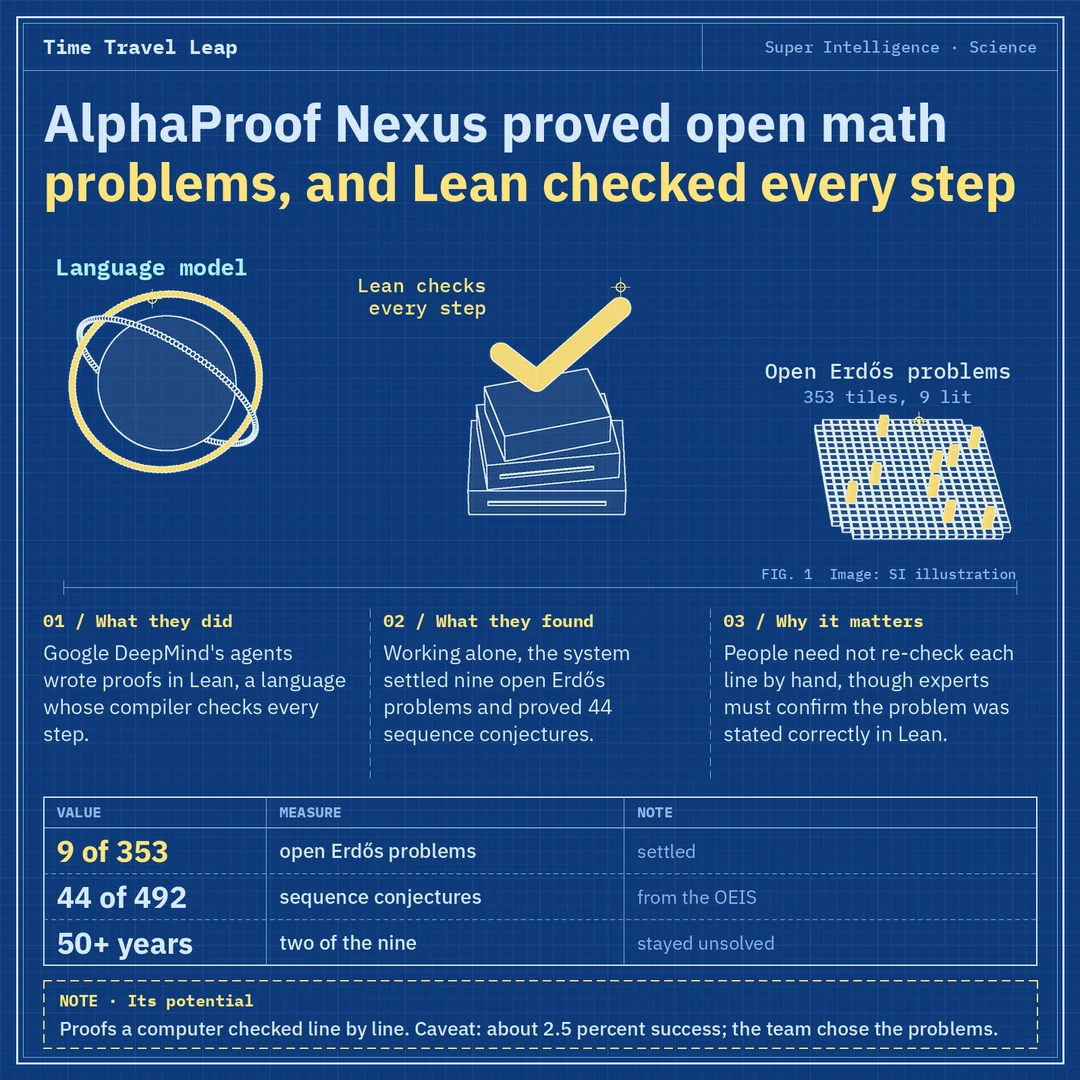
Google DeepMind's system settled nine open Erdős problems, two of them unsolved for more than 50 years. A proof checker verified every line. (Image: SI illustration)
Can a Super Intelligence system do new mathematics that nobody has to take on trust? A team at Google DeepMind says its system, AlphaProof Nexus, has started to. Their paper appeared in Science on Oct. 8, 2026.
What the researchers did
Large language models are good at math, but they sometimes make subtle mistakes. So the team had Super Intelligence agents write their proofs in Lean, a programming language whose compiler checks every logical step. A wrong proof can't slip through, because Lean simply won't accept it.
Nineteen of the paper's 21 authors are at Google DeepMind in London. The others are a mathematician at Aarhus University in Denmark and a researcher at Google in Mountain View.
What they found
Working on its own, the system resolved nine of 353 open Erdős problems, questions posed by the mathematician Paul Erdős that serve as a benchmark in fields such as combinatorics and number theory. Two of those had remained unsolved for more than 50 years, according to the AAAS release on the work.
It also proved 44 of 492 conjectures from the On-Line Encyclopedia of Integer Sequences, a public database of more than 400,000 integer sequences.
One detail stands out. The paper reports that "even a basic agent alternating LLM-based generation with Lean-based verification replicated the Erdős successes." In other words, pairing a language model with a strict checker was enough to repeat the Erdős results.
Its potential
The system is now being used in research areas such as algebraic geometry and quantum optics. The bigger idea is trust: when a machine checks every step, people don't have to re-check each line of a machine-made proof by hand, though experts still need to confirm that the Lean statement of the problem is correct.
The limits
Nine of 353 is a success rate of about 2.5 percent. This is a careful step, not a machine that solves mathematics in general.
The research team chose the problems and helped write them out in Lean, so people still framed the questions the Super Intelligence system answered.
This explainer draws on the paper's abstract, the journal's editor's summary and the AAAS release. It does not draw on the full text.
So the fair summary is a striking but narrow one: a Super Intelligence system closed a handful of long-open problems, and a computer checked every line of its work.
Get the week's top 5 stories: Subscribe free.
Sources
- Tsoukalas G., Kovsharov A., … Kohli P., Chaudhuri S. et al. “Advancing mathematics research with AI-driven formal proof search.” Science 394(6820), 234–239. Published October 8, 2026. DOI: https://doi.org/10.1126/science.aej2213
- AAAS release on EurekAlert: https://www.eurekalert.org/news-releases/1146436
Sources last checked Oct. 18, 2026.
Follow Time Travel Leap on X for the next post.